-
Posted on: 16 Jun 2026
-
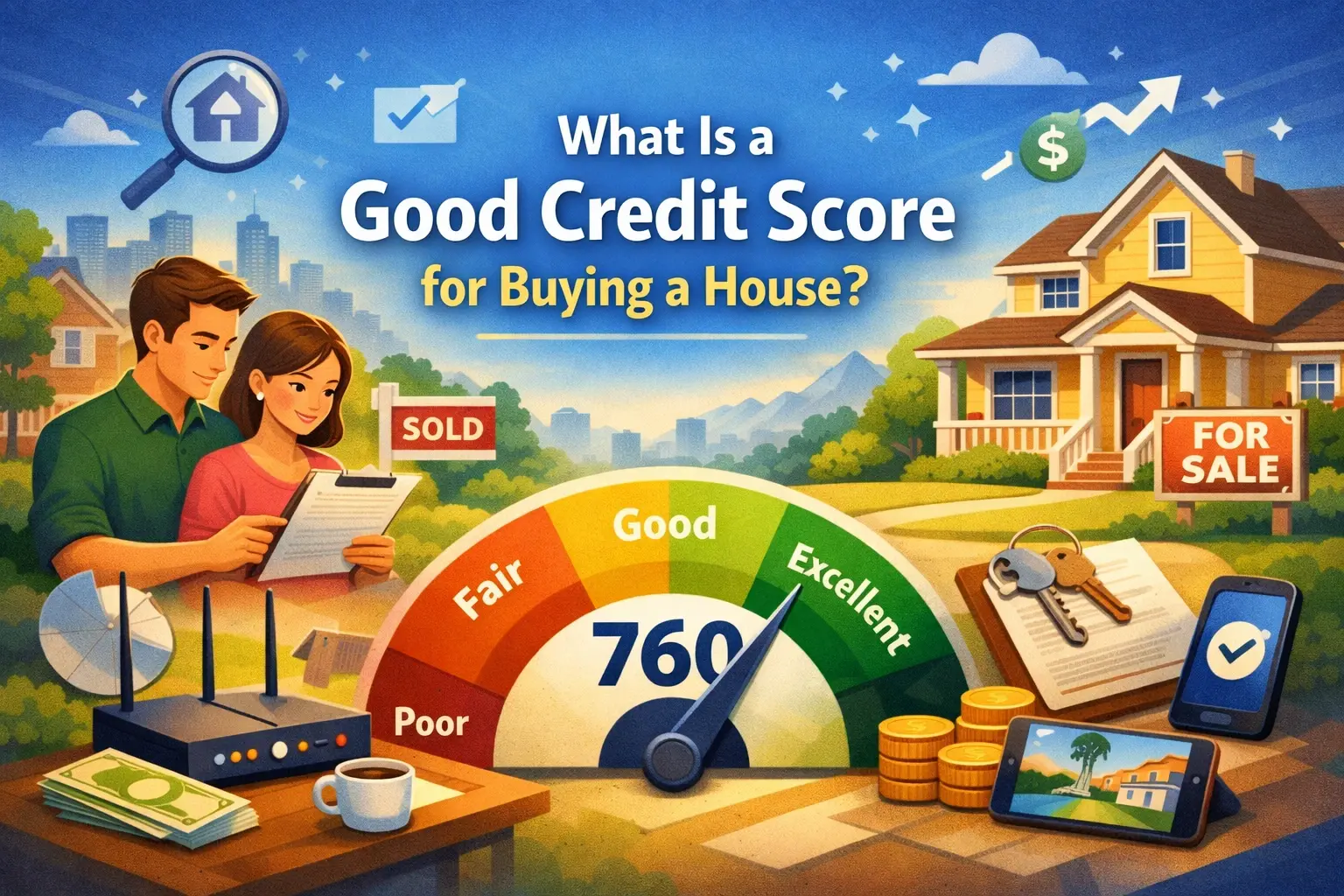
A good credit score for buying a house depends on what you want from the mortgage. The minimum to qualify is 500 with an FHA loan (10% down) or 580 with 3.5% down. To qualify for a conventional loan, most lenders want 620 or higher. But the score that unlocks the best mortgage rates — and the one worth targeting if you have time — is 760 or above. On a $300,000 30-year mortgage, improving your score from 620 to 760 saves $156 per month and $56,103 in total interest over the life of the loan, according to myFICO data from November 2025. On a $600,000 loan, the difference between a 760 and a 620 score is nearly a quarter of a million dollars in total interest paid. There is a minimum credit score to get into the house. There is a very different credit score to get into the house without overpaying for it.
Key Findings at a Glance
Loan Type
Minimum Score
Recommended Score
Down Payment
Notes
FHA Loan
500 (10% down) / 580 (3.5% down)
620+
3.5–10%
Mortgage insurance for the life of the loan in most cases
Conventional Loan
620*
740+
3–20%
PMI required below 20% down; drops off at 78% LTV
VA Loan
No official minimum
620 (most lenders)
0%
Veterans/active duty only; no PMI
USDA Loan
640 (automated)
660+
0%
Rural/suburban eligible properties only
Jumbo Loan
700–720
740+
10–20%
Above conforming loan limits ($802,650 in 2026)
*Fannie Mae eliminated its minimum credit score requirement on November 15, 2025. Most lenders still maintain internal minimums of 620 or higher. Individual lender overlays of 20–40 points above program minimums are common.
Mortgage rates as of June 2026: The current average rate on a conventional 30-year fixed-rate mortgage for a borrower with a 700 credit score is 6.91%, according to Curinos data as of June 2026.
Introduction
Most people approach the credit score question backwards. They ask "what's the minimum score I need to get a mortgage?" — then aim for that number.
That's the wrong question. Or rather, it's only half the question.
The minimum score gets you through the door. The score above it determines what you pay for everything inside. And in a housing market where the average conventional 30-year fixed mortgage rate sits at 6.91% in June 2026 — well above the historic lows many buyers remember— the difference between a mediocre score and an excellent one translates directly into hundreds of dollars every month for decades.
The median home buyer FICO score hit a record 768 in May 2025, according to Optimal Blue data — reflecting a market where elevated home prices and interest rates have progressively priced out buyers with weaker credit profiles. The buyers closing deals are, by and large, those who came in with strong credit. That's not a coincidence. It's a consequence of how mortgage pricing works.
This guide covers both questions: what score you need to qualify, and what score you need to avoid leaving tens of thousands of dollars on the table. It also covers the change that happened in November 2025 that most prospective buyers haven't heard about — and what it means for people with thin or imperfect credit histories.
The Credit Score Tiers That Actually Matter for a Mortgage
Before diving into loan types, it helps to understand how lenders think about credit scores. They don't evaluate borrowers on a smooth continuum. They use tiers — predefined score ranges that correspond to risk categories and, directly, to interest rates.
Here's how those tiers translate to real costs on a $400,000 30-year fixed-rate mortgage, based on myFICO average APR data from May 2026:
Credit Score Range
Estimated APR
Monthly Payment
Total Interest
760–850
~6.52%
~$2,535
~$512,600
700–759
~6.74%
~$2,588
~$531,680
680–699
~6.91%
~$2,630
~$546,800
660–679
~7.12%
~$2,686
~$567,160
640–659
~7.55%
~$2,801
~$608,360
620–639
~8.00%
~$2,935
~$656,600
Based on myFICO rate data, May–June 2026. Actual rates vary by lender, property, and loan terms.
The difference between a 760 score and a 620 score on a $500,000 loan is $433 per month and $155,954 in total interest over 30 years — for the same house, the same loan amount, the same down payment.
And that's before PMI. On a $380,000 loan with less than 20% down, PMI for a 620-score borrower could run $530 to $760 per month compared to $114 to $171 for a 760-score borrower — an additional $400 per month beyond the rate difference alone.
The math is stark. A 140-point improvement in credit score, on a home purchase you were going to make anyway, can save more money than most people earn in a year. That is the real reason credit score matters for home buying — not to qualify, but to control the cost of what you're buying.
Credit Score Requirements by Loan Type
Conventional Loans — The 620 Floor That Most Lenders Keep
Conventional mortgages — loans not backed by any government agency, conforming to Fannie Mae or Freddie Mac guidelines — are the most widely used mortgage product in the U.S.
Fannie Mae eliminated its minimum credit score requirement on November 15, 2025, updating its Selling Guide to evaluate borrowers on overall credit risk factors rather than a single score threshold. This is a meaningful policy shift — it opens the door for borrowers with thin credit histories, non-traditional income, or unconventional financial profiles to be evaluated holistically rather than screened out by a single number.
The practical catch: most lenders still maintain their own internal credit score minimums, typically 620 or higher for conventional loans, as individual lenders set "overlay" requirements above program minimums. Until lenders broadly adjust their own underwriting practices to reflect Fannie Mae's new framework — which takes time — borrowers below 620 will still find conventional loan approvals difficult to obtain in practice.
For buyers who can qualify:
620–659: Qualifies, but with the highest rate tiers and significant PMI costs if the down payment is below 20%
660–699: Better rates, lower PMI costs; worth targeting as a minimum for a conventional purchase
700–759: Good rates; the tier most buyers land in; meaningfully lower lifetime cost than 660s
740–759: Excellent rates; most lenders' threshold for best-tier pricing on many products
760+: Best available rates; every basis point improvement above 760 has diminishing marginal returns
Even a few points can move you into a better tier. A score of 718 versus 720 — a two-point difference — can shift you into a lower rate tier and save money. Slipping into a lower tier just before closing, however, can trigger a rate increase.
FHA Loans — The 580 Threshold Most Buyers Actually Need
FHA loans are the most accessible mortgage product for buyers with imperfect credit. The Federal Housing Administration insures these loans, which allows lenders to extend credit to borrowers who wouldn't qualify for conventional financing.
The official FHA minimums:
500–579: Qualify with a 10% down payment
580+: Qualify with a 3.5% down payment
In practice, most FHA lenders look for minimum scores between 580 and 600, with 580 as the widely accepted practical floor, rather than the official 500. Lenders apply their own overlays on top of FHA guidelines, and very few will extend FHA loans to borrowers with scores in the 500–579 range in practice.
HMDA data for 2024 shows the average FHA borrower had a credit score of 692 — which tells you where the competitive middle of the FHA market sits. Qualifying at 580 is possible. Qualifying comfortably, with multiple lenders competing for your business, happens closer to 650 and above.
The FHA trade-off is mortgage insurance. FHA loans require both an upfront mortgage insurance premium (1.75% of the loan amount) and an annual MIP that runs for the life of the loan in most cases. On a $200,000 loan, the monthly MIP can add up to over $70,000 paid over 30 years — which is why buyers who started with FHA financing often refinance to a conventional loan once they've built 20% equity and their credit has improved.
For buyers who need to get into a home now and will have time to refinance later, FHA at 580–620 is a viable path. For buyers who can wait 6–12 months to push their score above 660 or 700, the long-term cost difference makes waiting worth serious consideration.
VA Loans — The Most Underrated Mortgage for Eligible Buyers
If you are an eligible veteran, active-duty service member, or qualifying surviving spouse, VA loans are the best mortgage product in this comparison — and the credit score requirements are more accessible than most veterans realize.
The VA itself sets no minimum credit score. The requirement is eligibility, not a specific score. Most VA lenders require at least a 620 credit score, with some accepting 580, and HMDA data shows the average VA borrower had a credit score of 725 in 2024.
The VA loan advantages over FHA and conventional loans are significant:
Zero down payment required
No monthly private mortgage insurance (PMI)
Generally, lower interest rates than conventional loans
No limit on seller concessions
A new survey shows many veterans overestimate the credit score they need for a VA loan — some assuming they need 700 or higher when 620 or even 580 can qualify them. If you have VA eligibility, this loan type should be the first option you evaluate, not the last.
USDA Loans — Rural and Suburban Buyers, Zero Down
USDA loans provide zero-down-payment financing for homes in eligible rural and suburban areas, backed by the U.S. Department of Agriculture. The geographic restriction is real but broader than most buyers assume — significant portions of suburban America fall within USDA-eligible boundaries.
USDA loans typically require a 640 credit score for automated underwriting approval.</cite> Manual underwriting — a more intensive review process — may allow lower scores with compensating factors, but the standard path requires 640 as the minimum to move through the system efficiently.
For buyers in eligible areas with scores at or above 640, USDA loans offer a compelling combination: no down payment, competitive rates, and geographic coverage that reaches further into suburban markets than most buyers realize. Checking USDA property eligibility at your target address costs nothing and takes two minutes.
The November 2025 Change That Matters
One development from late 2025 deserves specific attention because it is still not widely understood among prospective buyers.
On November 15, 2025, Fannie Mae eliminated its minimum credit score requirement for conventional loan eligibility. The government-sponsored enterprise updated its Selling Guide to move from a minimum-score threshold to an evaluation of "overall credit risk factors.
What this means in plain language: Fannie Mae is signaling that a borrower with a thin credit history — someone who has used credit minimally, pays everything on time, but simply doesn't have enough accounts to generate a high score — can be evaluated on the full picture of their financial behavior rather than screened out by a single number.
It also means that a borrower with a recent credit setback — a period of medical bills, a divorce, a temporary job loss — who has since rebuilt responsible credit habits may be evaluated more favorably than the old minimum-score framework allowed.
The practical timeline: individual lenders and mortgage servicers implement Fannie Mae guideline changes on their own schedules, and the shift toward holistic risk evaluation will happen gradually across the industry. <cite index="26-1">The shift signals that the lending industry is moving toward more holistic borrower risk evaluation, which may benefit buyers who have high income and savings but a credit score slightly below traditional thresholds.</cite>
If you have been told your score disqualifies you from conventional financing, it is worth having a current conversation with a lender rather than relying on what was true a year ago.
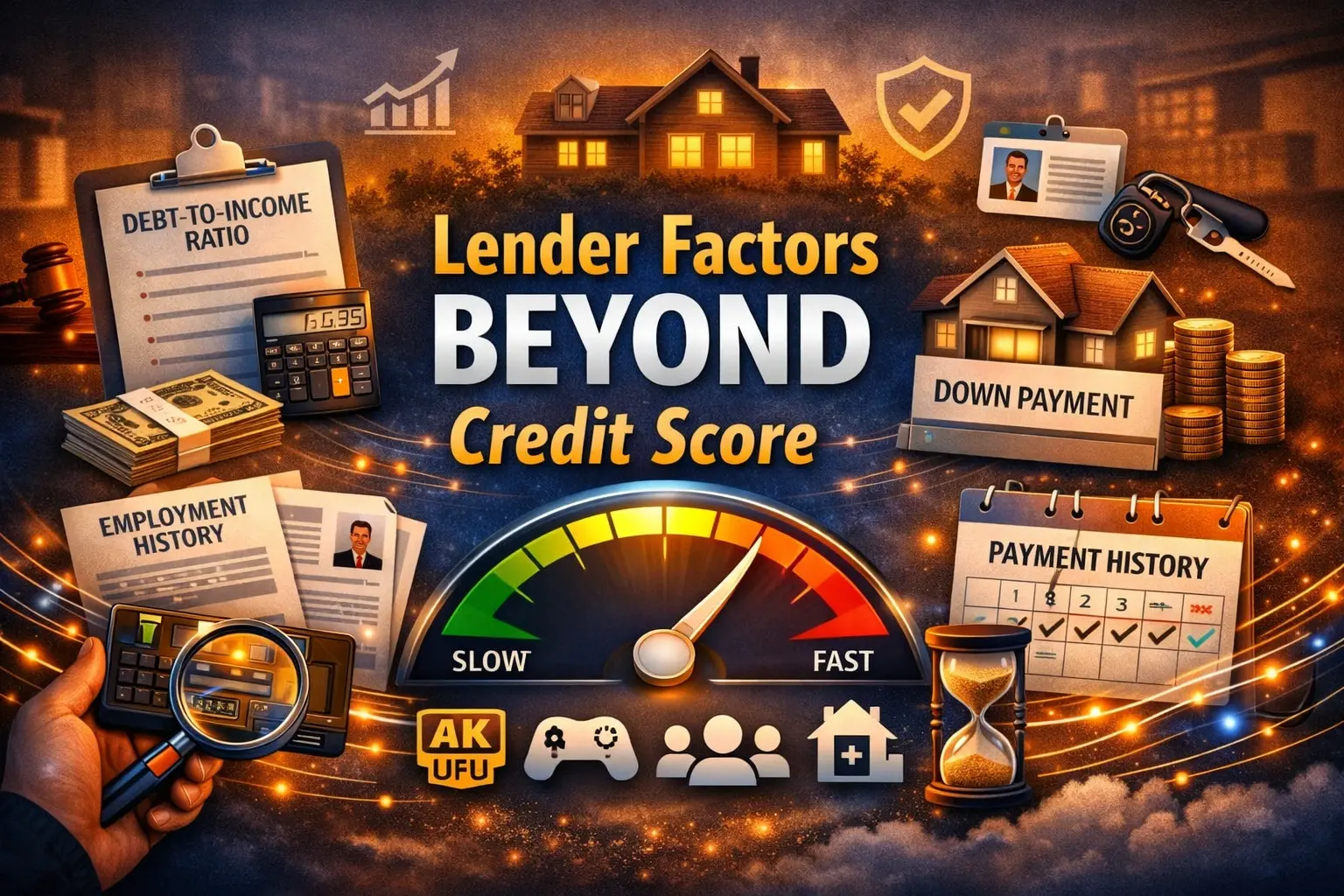
What Lenders Look at Beyond Your Credit Score
Credit score is the most discussed variable in mortgage qualification — and genuinely important — but it is not the only variable. Lenders evaluate the full picture of your financial situation.
Debt-to-income ratio (DTI): Your total monthly debt payments divided by your gross monthly income. Most conventional lenders want a DTI below 43–45%. FHA allows up to 57% in some cases. A high income can compensate for a moderate credit score; a high DTI can undermine a strong score.
Down payment: Larger down payments reduce lender risk and often unlock better rates even at the same credit score tier. Below 20% down on a conventional loan triggers PMI. Below 10% down on an FHA loan with a score below 580 is not available.
Employment and income stability: Two years of employment history in the same field is the standard lenders look for. Self-employed borrowers face additional documentation requirements.
Which credit score lenders actually use: Lenders pull reports from all three major credit bureaus and use your middle score. If you're buying with a co-borrower, they take both borrowers' middle scores and use the lower one. This is an important planning detail for couples: if one partner has a 780 and the other has a 640, the mortgage is priced at the 640 level.
FICO 10 T and VantageScore 4.0 transition: In October 2022, the FHFA announced that lenders would be required to deliver FICO 10 T and VantageScore 4.0 scores when selling mortgages to Fannie Mae or Freddie Mac, with an estimated implementation timeline of late 2025. These newer scoring models weight recent payment behavior and trended data differently than classic FICO models. The transition is ongoing, and borrowers with improving credit trajectories may benefit from the newer models' emphasis on recent positive behavior.
The Real Cost of a Lower Credit Score — In Dollars
The mortgage industry presents credit score requirements in terms of minimums. The more honest framing is cost.
Minimum scores determine whether you can get a mortgage. The tier your score puts you in determines how expensive that mortgage is — every month, for 30 years.
On a $300,000 30-year fixed-rate mortgage, improving your score from 620 to 760 saves $156 per month and $56,103 in total interest, based on myFICO data from November 2025.
On a $300,000 mortgage with 20% down, a borrower with a 760–850 score saves $91,757 in interest compared to a borrower with a 620–639 score, according to myFICO data from July 2025.
On a $500,000 loan, the gap is $433 per month and $155,954 over 30 years. On a $600,000 loan — not unusual in major metro housing markets — the difference between a 760 and a 620 score approaches a quarter of a million dollars in total interest paid.
These are not marginal differences. They are the financial consequences of the credit score you bring to closing.
The question worth sitting with: if your score is currently 650 and you could push it to 720 in 8 months before applying, what would those 8 months of credit improvement be worth? On a $400,000 mortgage, the answer is likely $40,000–$60,000 in lifetime interest savings. Eight months of strategic credit work — paying down balances, disputing errors, maintaining on-time payments — to save the equivalent of one to two years of mortgage payments.
How to Improve Your Credit Score Before Buying
If your score is below where you want it before applying for a mortgage, the timeline and the specific actions matter.
What moves your score fastest:
Credit utilization — the fastest lever. Your credit utilization ratio — the balance on your revolving accounts divided by their credit limits — accounts for 30% of your FICO score. Reducing utilization from 60% to below 30% can move a score by 20–50 points within one to two billing cycles. Getting below 10% often adds additional points. This is the fastest and most reliable score improvement action available to most borrowers.
Dispute inaccurate items. Credit reporting errors are among the most common consumer complaints the CFPB receives, with incorrect information on credit reports representing a significant and documented problem in the consumer financial system. An error being removed — a collection that isn't yours, a late payment recorded for a month you paid on time, an account with a wrong balance — can shift a score significantly within one dispute cycle. Pulling your reports from all three bureaus and reviewing them before applying for a mortgage is not optional. It's preparation.
Payment history — the biggest factor, the slowest fix. Payment history accounts for 35% of your FICO score — the largest single factor. Making every payment on time from today forward is non-negotiable, but the impact builds over months. A single 30-day late payment from 18 months ago hurts less than one from 6 months ago. The trajectory matters.
Age of accounts — don't close things. The average age of your credit accounts contributes to your score. Closing a credit card — even one you don't use — reduces your average account age and can lower your score. In the months before a mortgage application, the guidance is to leave existing accounts open and avoid opening new ones.
Hard inquiries — time them carefully. Every credit application generates a hard inquiry that temporarily reduces your score. Mortgage rate shopping is an exception: FICO treats multiple mortgage inquiries within a 45-day window as a single inquiry for scoring purposes, so you can shop lenders aggressively without score damage. Outside of mortgage shopping, avoid new credit applications in the 6–12 months before applying.
What professional credit repair addresses:
Some of the factors above — removing inaccurate negative items, navigating the dispute process across all three bureaus, understanding which items are disputable versus verified — benefit from professional assistance. The dispute process has become more difficult for consumers navigating it independently: as documented earlier in 2026, Experian's consumer complaint resolution rate dropped sharply when CFPB enforcement capacity was reduced, and TransUnion showed similar patterns. Professional credit repair firms with established dispute processes, documentation practices, and legal escalation capabilities are better positioned to achieve results in the current environment than a consumer filing disputes online for the first time.
The timeline for meaningful score improvement through professional credit repair is typically 3–6 months for straightforward inaccuracies and 6–12 months for complex cases involving multiple derogatory items or identity theft. For buyers who are 6–12 months from a planned home purchase, starting the credit review process now — before the mortgage application — is the highest-value preparation step available.
If you want to understand exactly what is on your credit reports, which items might be disputable, and what realistic score improvement looks like for your specific situation before a home purchase, creditrepairease.com provides free consultations with experienced credit advisors. Call (888) 803-7889 to schedule a review.
Research Insights: The Changing Mortgage Credit Landscape
Two trends are reshaping the relationship between credit scores and mortgage access in 2026, and both are relevant to buyers planning a purchase in the next 12–18 months.
The median buyer score is at a record high — which means competition is tighter. The median FICO score for purchase loans reached 768 in May 2025, according to Optimal Blue — a record high that reflects a market where elevated prices and rates have compressed the buyer pool toward higher-credit borrowers. The buyers still purchasing are disproportionately those with strong credit. For buyers with scores below 700, this doesn't mean the market is closed — but it means the competition you face is, on average, better-credentialed than in previous years.
The scoring model transition matters for recent credit improvers. The transition to FICO 10 T and VantageScore 4.0 scoring models — which weight recent payment behavior and account for trended data — is ongoing. These newer models are more favorable to borrowers with improving credit trajectories: someone who had a rough patch two years ago and has been consistently improving since will be scored more favorably under trended models than under classic FICO models that weight the negative history more heavily. If your credit has improved recently, asking lenders which scoring model they're using for their current applications is a worthwhile question.
Future Outlook
The mortgage credit score landscape in 2026 is genuinely in transition, shaped by three forces moving simultaneously.
Fannie Mae's holistic evaluation shift will take 12–24 months to fully manifest in lender behavior. As it does, thin-file borrowers — those with limited credit history rather than damaged credit — will have more pathways to conventional financing. The change benefits first-generation homebuyers and recent immigrants disproportionately.
Rate trajectory. Experian's chief product officer for housing noted in 2026 that "over the next six to 12 months, we may see modest declines in mortgage rates, but they'll continue to respond to broader economic factors."</cite> Modest rate declines would compress the total dollar difference between score tiers somewhat, but not eliminate it — the pricing differential between a 620 and a 760 score is structurally built into how mortgage risk is priced.
Credit repair access is expanding. AI-assisted dispute management, automated credit monitoring, and more accessible professional credit repair services are reducing the friction for consumers trying to improve their scores before a home purchase. The combination of better tooling and improving regulatory clarity around FCRA rights — despite the current CFPB pullback — creates more pathways to meaningful score improvement than existed even five years ago.
Frequently Asked Questions
What credit score do you need to buy a house in 2026?
The minimum credit score to buy a house is 500 with an FHA loan and a 10% down payment, or 580 with an FHA loan and a 3.5% down payment. To qualify for a conventional loan, most lenders require at least 620, though Fannie Mae eliminated its official minimum score requirement in November 2025. For the best mortgage interest rates, you need a 760 or higher. The practical target for most buyers is 660–700 to qualify comfortably for conventional financing, and 740+ to access the lowest available rates.
What is a good credit score to buy a house?
A good credit score for buying a house is 700 or above for conventional loan qualification at competitive rates, and 760 or above to access the best available rates. A score of 620–660 qualifies you for conventional financing but at meaningfully higher interest rates. A score of 580–619 qualifies for FHA financing with 3.5% down. Based on myFICO data, the difference between a 620 and a 760 score on a $300,000 mortgage is $156 per month and over $56,000 in total interest over 30 years.
Can I buy a house with a 600 credit score?
Yes, with an FHA loan. A 600 credit score qualifies for FHA financing with a 3.5% down payment at most lenders, which accept scores as low as 580 for the minimum down payment option. You will not qualify for a conventional loan at 600, which most lenders require to be 620 or higher. VA loans are available at 600 for eligible veterans at many lenders. The trade-off is higher interest rates and, with FHA, mandatory mortgage insurance for the life of the loan in most cases.
How much does a better credit score save on a mortgage?
The savings are substantial. On a $300,000 30-year mortgage, improving your score from 620 to 760 saves approximately $156 per month and $56,103 in total interest, according to myFICO data from November 2025. On a $400,000 mortgage, the difference between a 620–639 score and a 760–850 score is approximately $91,757 in total interest. On a $500,000 loan, the gap reaches $155,954 over 30 years. PMI costs add to the monthly expense at lower score tiers, often $400+ per month, compared to buyers with 760+ scores on the same loan amount and down payment percentage.
How long does it take to improve a credit score before buying a house?
The timeline depends on what's holding the score down. Credit utilization improvements can reflect in your score within one to two billing cycles — 30 to 60 days. Disputing inaccurate negative items through a professional credit repair process typically takes 3 to 6 months for straightforward cases, or 6 to 12 months for complex situations involving multiple items or identity theft. Payment history improvements build over months and years. For most buyers in the 600–650 range targeting 700+, a focused 6–12-month credit improvement effort before applying for a mortgage is a realistic timeline.
Does getting pre-approved hurt your credit score?
Yes, but minimally. A mortgage pre-approval triggers a hard inquiry on your credit report, which typically reduces your score by 5 points or fewer. The impact is temporary — most hard inquiries fall off your score calculation after 12 months. Importantly, FICO treats multiple mortgage inquiries within a 45-day window as a single inquiry, so shopping multiple lenders for the best rate during that window does not cause cumulative damage. Check your credit score before starting the pre-approval process, and do not apply for any other credit (cards, auto loans) in the months surrounding your mortgage application.
What happens if one spouse has a low credit score when buying a house together?
When buying with a co-borrower, lenders use both borrowers' middle credit scores and apply the lower one to determine loan pricing and qualification. If one spouse has a 780 and the other has a 620, the mortgage is underwritten and priced at the 620 level. Two options exist: apply with only the higher-scoring spouse (which may affect the income used for qualification), or invest in improving the lower-scoring spouse's credit before applying. For couples where one partner has significantly lower credit, a professional credit review to identify what is driving the lower score — and what can be resolved — is often the best first step. Call (888) 803-7889 to speak with a credit advisor about your specific situation before your mortgage application.
Should I use FHA or conventional if my credit score is around 620?
At 620, you are at the minimum threshold for most conventional lenders and comfortably within the FHA qualification range. The right choice depends on your down payment and how long you plan to stay in the home. FHA allows 3.5% down but requires mortgage insurance for the life of the loan in most cases, which adds high long-term cost. Conventional at 620 requires PMI below 20%, but PMI drops off automatically at 78% LTV. If you can make a 5–10% down payment and have a stable income, a conventional loan at 620 often makes more long-term financial sense than FHA — particularly if you work on improving your credit score over the next year and refinance to better terms when you hit 660–700.
Conclusion
There are two answers to "what is a good credit score for buying a house" — and they serve different purposes.
The answer to "what score do I need to get approved" is 500 for FHA with 10% down, 580 for FHA with 3.5% down, and 620 for most conventional financing. Those are the floors.
The answer to "what score do I need to avoid overpaying" is 740 to 760 or above. That's where the best mortgage rates live, where PMI costs drop substantially, and where the difference between your score and a lower-credit borrower's score is measured in tens of thousands of dollars in lifetime interest.
The gap between those two answers is where credit preparation happens. A buyer with a 640 score who waits 8 months, pays down balances, disputes inaccurate items, and applies with a 720 is not just more likely to be approved — they're buying the same house at a meaningfully lower total cost.
If you're planning a home purchase in the next 6–18 months and want to know exactly where your credit stands, what items on your reports might be inaccurate or disputable, and what realistic improvement looks like for your specific situation, creditrepairease.com offers free consultations with credit advisors who review your three-bureau reports in detail. Call (888) 803-7889 to schedule your review before your mortgage application.
What Is a Good Credit Score for Buying a House?

Krystin Bresolin