How to Identify Mistakes on Your Credit Report
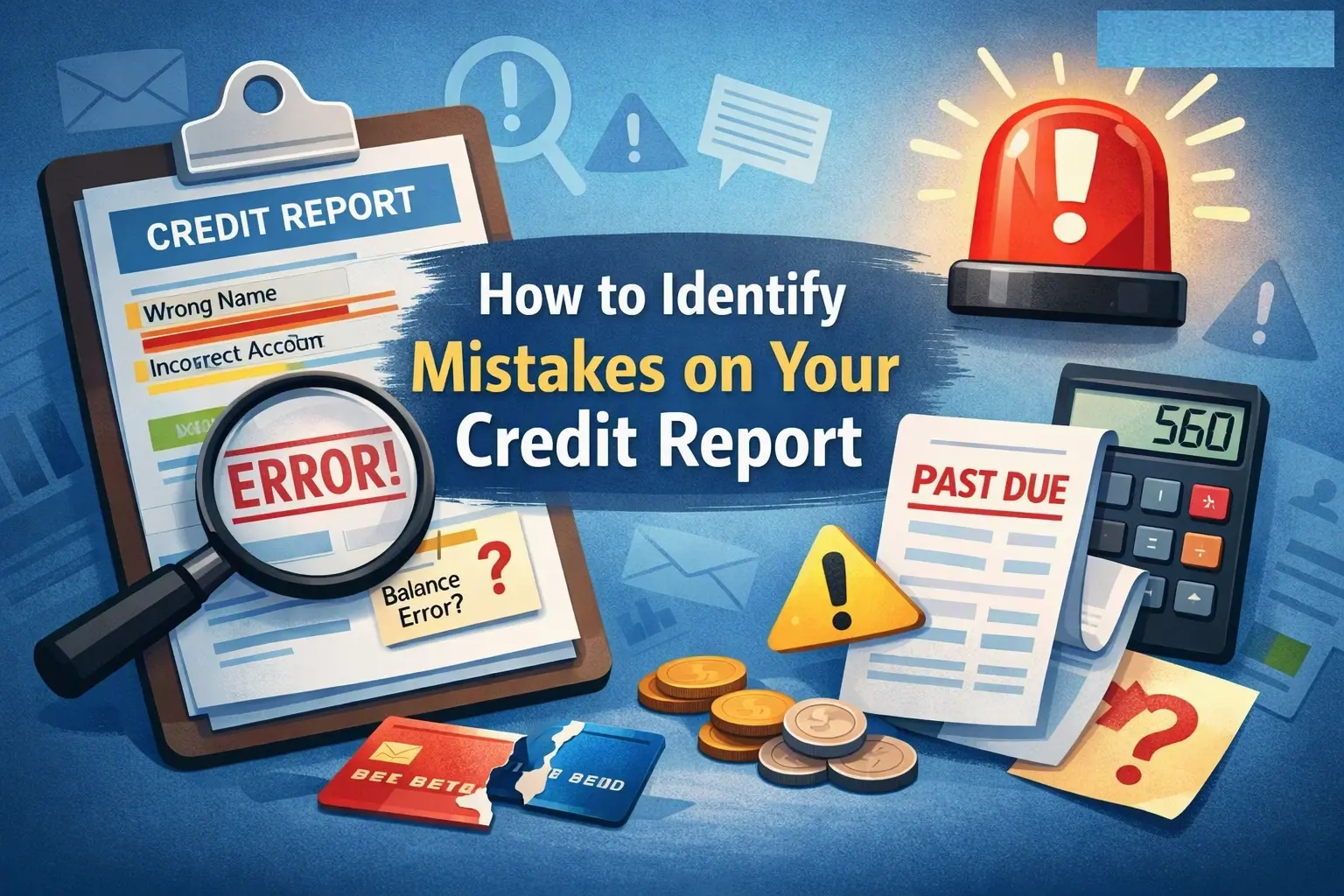
To identify mistakes on your credit report, pull your free reports from Equifax, Experian, and TransUnion at AnnualCreditReport.com, then review five areas line by line: personal identifying information, account status and payment history, balances and credit limits, public records, and hard inquiries. Look specifically for accounts you don't recognize, late payments you made on time, duplicate accounts, incorrect balances, and accounts that belong to someone with a similar name.
Federal Trade Commission research has found that roughly one in five consumers has a confirmed error on at least one of their three major credit reports, and Consumer Financial Protection Bureau complaint data shows credit reporting problems have become the single largest category of consumer complaints in the country.
Key Findings
The CFPB received approximately 5,806,800 credit or consumer reporting complaints in 2025.
Credit and consumer reporting complaints made up roughly 5.8 million of the more than 6.6 million total complaints filed with the CFPB in 2025, or about 88% of all submissions.
Complaint volume tied to the three nationwide credit bureaus has grown dramatically over time: in 2017 credit reporting made up about 30% of CFPB complaints, and by 2025 that figure had climbed past 80%.
An FTC study — still the most comprehensive federal accuracy study conducted to date — found that one in five consumers had an error on at least one of their three credit reports, and five percent of consumers had errors serious enough to potentially result in less favorable loan terms.
The same FTC research showed that one in four consumers identified errors that might affect their credit scores, and roughly one in twenty consumers saw a maximum score change of more than 25 points once errors were corrected.
Recent reporting indicates the rate at which credit bureaus resolve disputes in consumers' favor has fallen sharply: Experian resolved nearly 20% of complaints in consumers' favor in 2024, but that figure fell to less than 1% the following year, while TransUnion's relief rate began plunging in the summer of 2025 and by October was roughly half its prior level.
Introduction
A credit report is one of the few documents that quietly follows a person through nearly every major financial decision — mortgages, auto loans, credit card approvals, apartment applications, insurance premiums, and even some job offers. Yet most consumers never look closely at their reports until something goes wrong: a loan denial, an unexpectedly high interest rate, or a score drop with no obvious explanation.
That's a problem, because credit reporting errors are common and getting more common. Federal complaint data shows credit and consumer reporting issues have overtaken every other category submitted to the Consumer Financial Protection Bureau, and independent research continues to confirm that a meaningful share of credit files contain mistakes that can cost consumers real money. Understanding exactly what to look for — and how to look for it — is the first step toward protecting your credit standing.
This guide walks through where credit report errors typically show up, how to check each of your three reports systematically, and what current federal data reveals about the scale of the problem.
Why Credit Report Errors Happen
Credit reports are built from data submitted by thousands of separate "furnishers" — banks, credit unions, collection agencies, landlords, and other lenders — and compiled by Equifax, Experian, and TransUnion. Because the process depends on manual and automated data entry across so many separate institutions, mistakes can enter a file in several ways:
Mixed files: Information from a person with a similar name, address, or Social Security number gets attached to the wrong file.
Furnisher reporting errors: A lender reports a payment as late when it was actually on time, or reports a closed account as still open.
Outdated information: Paid-off debts, discharged bankruptcies, or resolved collections that should have aged off the report remain listed.
Identity theft and fraud: Accounts opened in a consumer's name without their knowledge appear on the report.
Processing delays: A dispute or correction that was resolved with one bureau doesn't get updated at the other two.
Where to Check: All Three Bureaus, Not Just One
A mistake on one bureau's report doesn't necessarily appear on the other two, because furnishers don't always report to all three agencies. Consumers are entitled to a free copy of their report from each bureau through AnnualCreditReport.com. Reviewing all three side by side — rather than relying on a single score-monitoring app — is the only reliable way to catch discrepancies between them.
The Five Areas to Review Line by Line
1. Personal identifying information: Check your name, current and former addresses, Social Security number, date of birth, and employer history. A wrong address or an unfamiliar variation of your name can be a sign of a mixed file, where someone else's information has been merged into your report.
2. Account status and payment history: This is where the most financially damaging errors tend to appear. Look for accounts marked "late" or "delinquent" that were actually paid on time, accounts listed as "open" that were closed years ago, or the same debt reported twice — once by the original creditor and again by a collection agency, which can make it look like two separate unpaid debts.
3. Balances and credit limits: An incorrect balance can distort your credit utilization ratio, which is one of the largest factors in most credit scoring models. Even a data entry error of a few hundred dollars can meaningfully affect a score.
4. Public records: Bankruptcies, judgments, and tax liens should be reviewed for accuracy and timing. Federal law limits how long most of this information can legally remain on a report, so items that have aged past their reporting limit should be removed.
5. Hard inquiries Every hard inquiry — generated when a lender pulls your credit for a new application — should correspond to an application you actually submitted. Inquiries you don't recognize can indicate identity theft or a lender pulling your report without proper authorization.
Red Flags That Point to a Mixed or Fraudulent File
Accounts you never opened
Employers you never worked for
Addresses you never lived at
A Social Security number that doesn't match yours exactly
Multiple listings of what appears to be the same debt
Research Insights
The gap between how often errors occur and how often they get fully corrected appears to be widening. Federal complaint volume has grown far faster than the underlying consumer population or lending activity would explain, which suggests the issue isn't simply more consumers checking their reports — it points to strain in the systems that furnishers and bureaus use to keep data synchronized across three separate databases.
At the same time, recent data on how bureaus resolve disputes shows a notable shift: two of the three major bureaus have seen the share of complaints resolved with actual relief for the consumer decline sharply, even as complaint volume keeps climbing. For consumers, that combination — more errors reported, fewer resolved with a correction — makes it more important than ever to catch mistakes early, document them thoroughly, and follow through on formal disputes rather than assuming an error will be caught automatically.
It's also worth noting that credit reporting problems don't affect all consumers equally. Federal analysis dating back several years has found that disputes are more common among consumers in Black and Hispanic neighborhoods and among younger consumers, and that reporting errors can have outsized effects on job prospects and homeownership access. That makes proactive, routine credit report review less of an optional habit and more of a practical safeguard for anyone applying for credit, housing, or insurance in the near future.
Consumer Impact
An uncorrected credit report error can follow a consumer well beyond a single loan application. A single inaccurate late payment can lower a credit score enough to push a borrower into a higher interest rate tier, which on a mortgage or auto loan can mean thousands of dollars in additional interest over the life of the loan. Beyond lending, credit reports are also used by landlords screening rental applicants and, in some states, by insurers setting premiums — meaning an error can raise costs in areas that have nothing to do with borrowing money at all.
Future Outlook
Oversight of the credit reporting industry is in a period of transition. Reporting has noted that federal enforcement activity aimed at the major credit bureaus has slowed compared to prior years, even as the volume of consumer complaints keeps rising. Consumer advocates argue that reduced federal oversight could make it harder for consumers to get errors corrected going forward, while the credit bureaus maintain that the overall accuracy rate of the reporting system remains high. Regardless of how oversight evolves, the practical guidance for consumers stays the same: check all three reports regularly, document errors carefully, and use the formal dispute process, since that process remains legally required regardless of the current regulatory climate.
Research Methodology
This article draws on data and reporting from the Consumer Financial Protection Bureau's 2025 Consumer Response Annual Report, CFPB complaint portal data compiled by outlets including PYMNTS and Banking Dive, the Federal Trade Commission's congressionally mandated study on credit report accuracy, and investigative reporting from ProPublica and CNBC Select on recent trends in credit bureau dispute resolution. Figures are cited to their source and reflect the most recently available federal data as of publication.
FAQ Section
How often should I check my credit report for errors?
Consumers are entitled to a free copy of their report from each of the three major bureaus every week through AnnualCreditReport.com. Reviewing each report at least once every few months — and always before applying for a major loan — gives you time to catch and correct errors before they affect a lending decision.
What's the difference between a credit report error and identity theft?
A credit report error is typically a data mismatch or furnisher mistake, such as a payment reported late in error. Identity theft involves someone else opening accounts or using your identity without permission. Both are corrected through a dispute process, but suspected identity theft should also be reported to the FTC and may require a fraud alert or credit freeze.
Do errors show up the same way on all three credit reports?
No. Because furnishers don't always report to all three bureaus, an error on your Experian report may not appear on your Equifax or TransUnion report at all. Checking all three separately is the only way to catch every discrepancy.
Can a credit report error lower my score even if I never missed a payment?
Yes. Incorrect balances, duplicate accounts, or an account mistakenly reported as delinquent can all lower a score even when the underlying payment history was accurate. Correcting the error typically restores the score, though it can take one or more billing cycles for the correction to fully process.
What information should I gather before disputing an error?
Collect account statements, payment confirmations, or any correspondence that supports your position, along with the specific report date and the exact wording of the disputed item. Detailed documentation tends to move disputes through the process faster and with fewer follow-up requests.
Does disputing an error hurt my credit score?
No. Filing a dispute itself does not affect your credit score. Only the outcome of the dispute — a correction or removal of inaccurate information — can change your score, typically for the better.
Conclusion
Credit report errors are more common than most consumers assume, and federal complaint data shows the volume of reported problems has continued to climb. Reviewing all three credit reports on a regular basis, checking each of the five key areas outlined above, and knowing the warning signs of a mixed or fraudulent file gives consumers the best chance of catching a mistake before it affects a major financial decision. Readers who want a closer look at their own credit profile, or who have found something on their report that doesn't look right, can find additional educational resources at Creditrepairease.com or speak with a specialist by calling (888) 803-7889.