What Is the Maximum Credit Score, and How Is It Calculated?
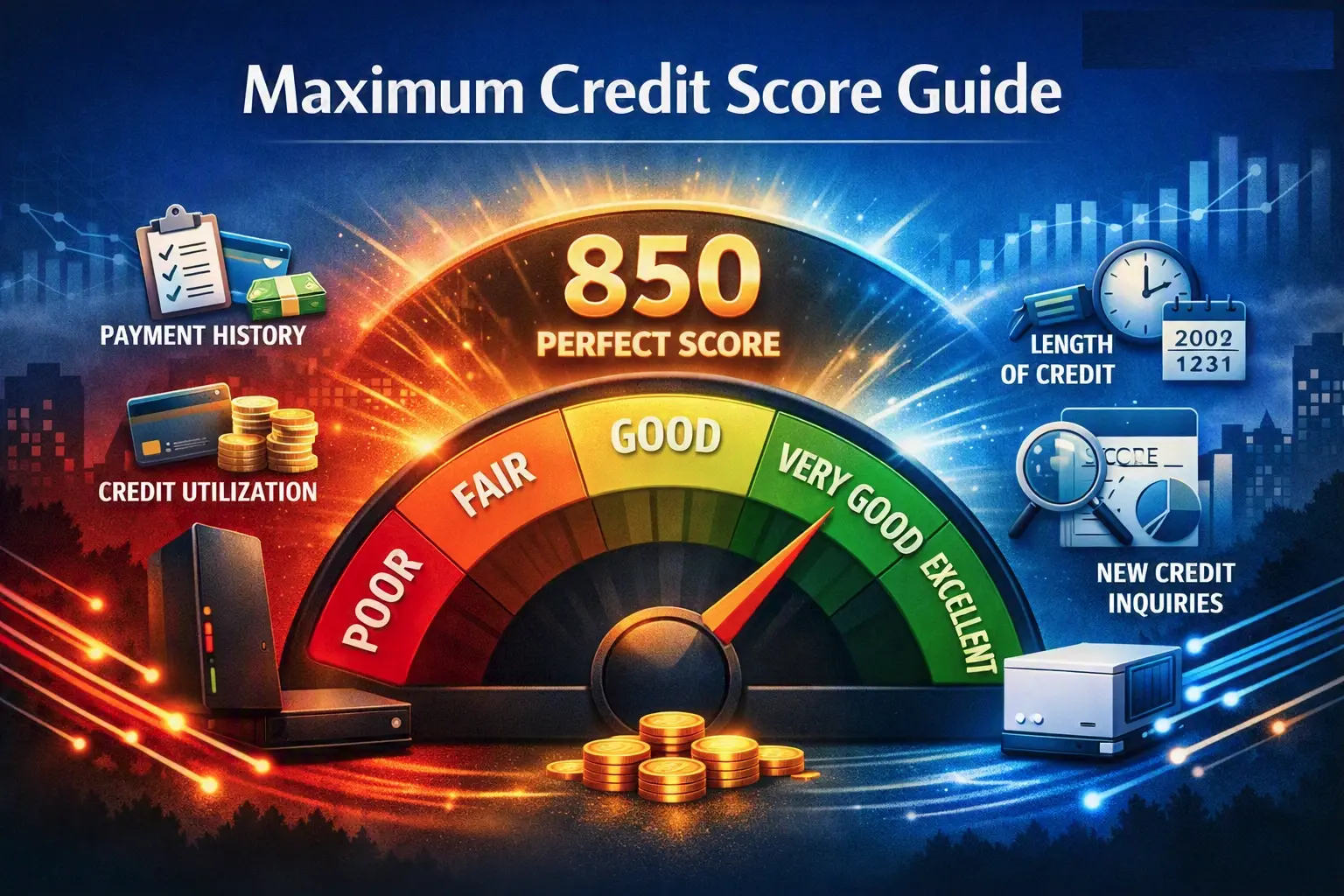
The maximum credit score under both major scoring systems — FICO and VantageScore — is 850. The scale runs from 300 (lowest) to 850 (highest). A score is calculated from data in your credit report, grouped into weighted categories: payment history, amounts owed, length of credit history, new credit, and credit mix. For the base FICO Score, those categories are weighted approximately 35%, 30%, 15%, 10%, and 10%, respectively. Very few consumers ever reach a perfect 850 — roughly 1.7% of the U.S. credit-holding population, according to recent Experian data — but scores in the high 700s and low 800s unlock nearly all the same lending benefits.
Key Findings
The top of the credit score scale is 850 for both FICO and VantageScore 3.0/4.0, the two models that generate the overwhelming majority of consumer credit scores in the United States.
Payment history and amounts owed (utilization) together account for roughly 65% of a base FICO Score, making them the two most influential levers for anyone trying to raise a score.
About 1.71% of U.S. consumers had an 850 FICO Score as of June 2026, up slightly from 1.67% a year earlier, according to Experian.
You don't need an 850 to get the best rates. Most lenders reserve their top pricing and approval tiers for scores around 760 and above.
The national average FICO Score was 713 in late 2025, and consumers with an 850 tend to carry far lower balances and use only a small fraction of their available credit.
Understanding the 300–850 Scale
Every mainstream U.S. credit score — whether it's a FICO Score pulled by a mortgage lender or a VantageScore displayed in a free banking app — is built on the same 300-to-850 range. FICO also produces specialty industry scores (used for auto loans and mortgages) that run from 250 to 900, but for the vast majority of everyday credit decisions, 850 is the number consumers are chasing.
Scores are typically grouped into tiers so lenders can quickly categorize risk:
Tier | FICO Range | VantageScore Range |
|---|---|---|
Poor | 300–579 | 300–600 |
Fair | 580–669 | 601–660 |
Good | 670–739 | 661–780 |
Very Good | 740–799 | 781–850 |
Exceptional | 800–850 | — |
Because FICO and VantageScore weigh data differently, the same credit file can produce two different numbers depending on which model — and which version of that model — a lender pulls. A score of 665, for example, lands in "fair" territory on FICO but can fall inside VantageScore's broader "good" band. Anyone reviewing their credit should confirm which scoring model and version they're looking at before assuming what tier they're in.
How the Score Is Actually Calculated
FICO discloses the five categories of data that go into its base score, along with their general weight for the average consumer:
Payment history — 35%. Whether accounts have been paid on time is the single biggest factor. Late payments, collections, charge-offs, and bankruptcies all fall here, and their impact depends on how recent, how frequent, and how severe they were.
Amounts owed — 30%. This category is dominated by credit utilization — the percentage of available revolving credit currently in use. Consumers with 850 scores average utilization in the single digits, far below the commonly cited "under 30%" guideline.
Length of credit history — 15%. This reflects the age of your oldest account, your newest account, and the average age across all accounts. It's one reason closing an old credit card can quietly hurt a score even if the card is never used.
New credit — 10%. Recent applications and hard inquiries fall here. Opening several accounts in a short window signals higher risk.
Credit mix — 10%. A demonstrated ability to manage different account types — revolving credit like cards and installment loans like auto loans or mortgages — contributes modestly to the score.
VantageScore uses broadly similar inputs but shifts the weighting, placing extra emphasis on consistent, long-term payment behavior and evaluating "amounts owed" through both balance levels and available credit. Neither model factors in income, employment, savings, or demographic information — a common misconception. Age itself is also not a scoring input, though older consumers tend to score higher simply because they've had more time to build a longer, cleaner credit history.
Research Insights: Why 850 Is So Rare
Reaching a perfect score isn't about one dramatic move — it's the byproduct of years of unremarkable, consistent behavior. Experian's analysis of consumers with an 850 FICO Score found they typically carry more open credit cards than average (5.8 vs. 3.9) yet use a much smaller share of their available limits, and they show zero delinquent accounts compared with roughly 1.5 delinquencies for the average American consumer. In practical terms, the data suggests the score rewards restraint over time — low balances relative to limits, an unbroken payment record, and credit accounts old enough to demonstrate a long track record — more than any single financial achievement.
The age skew reinforces this: the majority of consumers with an 850 are baby boomers or older, since length of credit history and years of clean payment behavior are difficult to accumulate quickly. For most borrowers, this means chasing a perfect score is a poor use of financial energy. The gap in loan pricing and approval odds between a 760 and an 850 is minimal; the gap between a 620 and a 760 is where meaningful savings live.
Consumer Impact
Where a score falls on the scale has direct financial consequences. Recent data shows the median APR on personal loan offers extended to consumers with "good" FICO Scores ran near 19%, compared with roughly 13% for consumers in the exceptional 800–850 range on the same loan type. Multiply that gap across a mortgage, auto loan, or years of credit card interest, and the practical difference between "good" and "exceptional" credit adds up to thousands of dollars — even though both borrowers are far short of a perfect 850.
This is also why credit monitoring and active credit management matter more than fixating on a single number. Errors on a credit report, old collection accounts, or outdated negative marks can suppress a score well below what a consumer's actual payment behavior would otherwise support.
Future Outlook
Scoring models continue to evolve. FICO 10T and VantageScore 4.0 both incorporate trended data — up to 24 months of account behavior rather than a single snapshot — giving more weight to sustained habits over time rather than a borrower's position on any one day. VantageScore 4.0 can also score tens of millions of consumers with thin or limited files that older FICO models couldn't evaluate at all. As lenders gradually adopt these newer models, the fundamentals are unlikely to change: on-time payments and low utilization will remain the two biggest levers, even as scoring becomes more sensitive to how consistently those habits are maintained.
Frequently Asked Questions
What is the highest possible credit score?
The highest possible score is 850 on both the base FICO Score and VantageScore 3.0/4.0, the two models used in the vast majority of U.S. lending decisions. Industry-specific FICO scores for auto and mortgage lending use a wider 250–900 scale, but 850 remains the number most consumers and lenders reference.
Do I need an 850 credit score to get approved for a mortgage or loan?
No. Lenders generally reserve their best rates for scores around 760 and above, and many approve borrowers well below that threshold depending on the loan type. An 850 offers little practical advantage over a score in the low 800s.
What percentage of people have a perfect 850 credit score?
About 1.71% of U.S. consumers with a credit file had an 850 FICO Score as of June 2026, according to Experian — roughly 1 in every 58 credit-holding adults.
Why did my score drop even though I pay everything on time?
Payment history is only 35% of the score. Rising utilization, a shortened average account age from a new card, a hard inquiry, or an error on your credit report can all lower a score even with a perfect payment record.
Does checking my own credit score lower it?
No. Checking your own score or report is a "soft inquiry" and has no impact. Only "hard inquiries" — typically triggered when a lender pulls your report for a new credit application — can cause a small, temporary dip.
Is FICO or VantageScore more important? FICO Scores are used in roughly 90% of U.S. lending decisions, according to the company, so they generally carry more practical weight. However, many free credit apps display VantageScore, so it's worth confirming which model you're viewing before comparing it to a lender's cutoff.
Can errors on my credit report keep me from reaching a higher score? Yes. Inaccurate late payments, accounts that don't belong to you, or outdated negative items can suppress a score below what your actual financial behavior supports. Reviewing your credit reports from all three bureaus regularly is one of the simplest ways to catch this. Consumers working through credit report accuracy issues can find educational resources at creditrepairease.com.
How long does it take to go from a fair score to a good or very good score? There's no fixed timeline — it depends on what's suppressing the score. Utilization can shift within a single billing cycle, while factors tied to account age or a serious delinquency take longer to improve. For questions specific to an individual credit file, readers can call (888) 803-7889.
📚More About Credit Score
Minimum Credit Score for a Boat Loan: What Lenders Require in 2026
October 13, 2026How Do I Find Out My Credit Score? 7 Free Ways to Check (2026)
October 6, 2026
How Does Borrowing Money Affect Your Credit Score?
August 20, 2026