What Purpose Does Equifax Serve?
Quick Answer
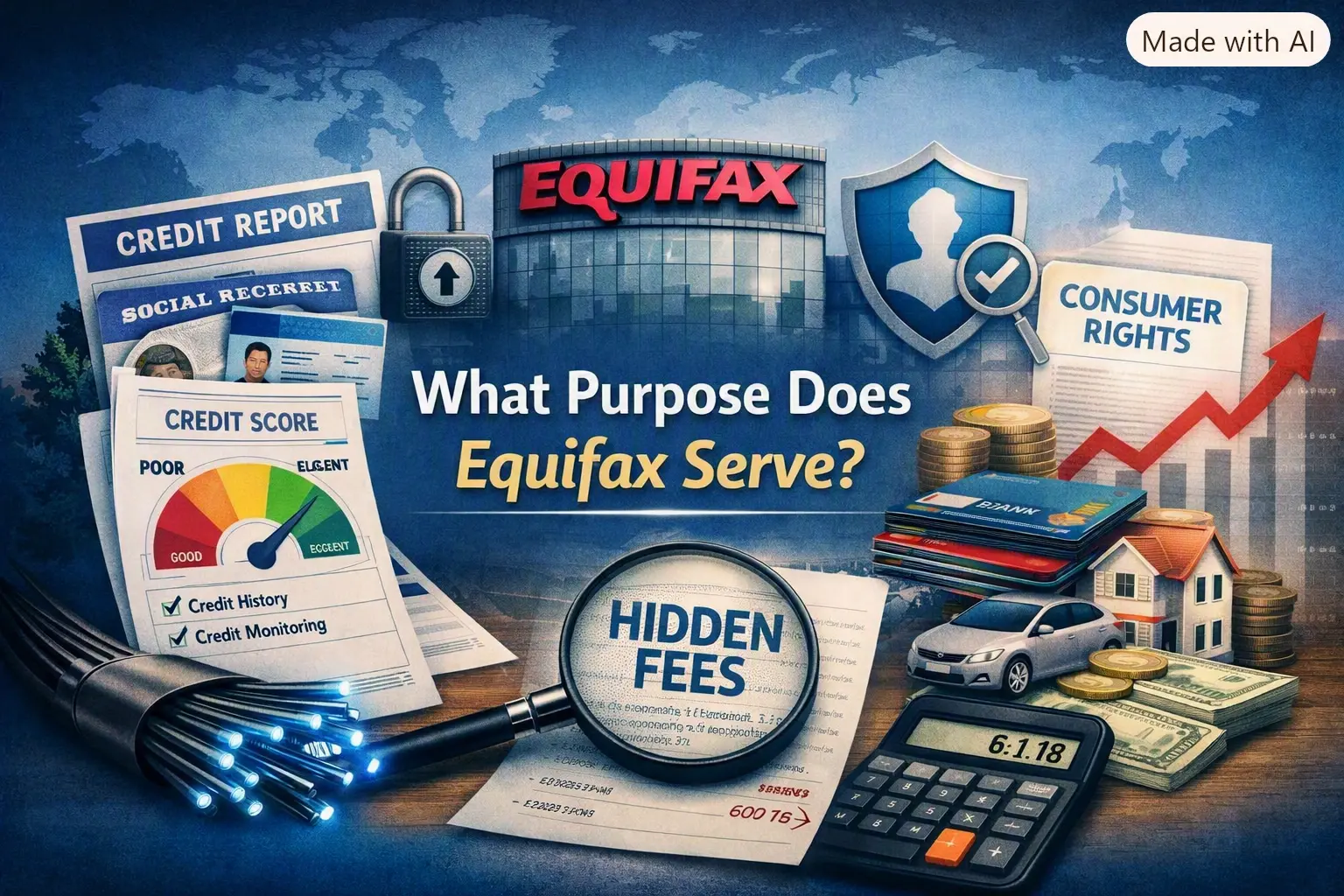
Equifax is a credit bureau — it collects and organizes information about how consumers use credit and shares it with authorized parties, such as lenders. It does not lend money, set interest rates, or make lending decisions. Equifax is one of three major nationwide credit bureaus in the United States, alongside TransUnion and Experian. Its core purpose is to compile consumer credit data into reports that lenders, landlords, employers, and insurers use to evaluate risk.
Key Findings
Equifax is a data compiler, not a lender. Credit bureaus do not make lending decisions — they supply information to the companies that do.
Equifax gathers data from lenders, credit card issuers, and collection agencies, then organizes it into a report unique to each of the three bureaus.
Equifax has operated in credit reporting for more than 125 years, dating back to its founding as a retail credit company in the 19th century.
A distinguishing feature of Equifax is its use of alternative data. Beyond traditional credit accounts, Equifax incorporates payment information from utility, internet, and phone providers, which can help consumers with thin credit files.
Equifax also runs Workforce Solutions, a service that verifies employment and income for businesses — a use of its data that has nothing to do with lending at all.
Federal law entitles consumers to review this data. Equifax must provide one free credit report every 12 months upon request, and following a 2019 settlement, consumers may request additional free reports each year.
Equifax's Core Function: Compiling, Not Lending
Equifax was founded in 1899 as the Retail Credit Company, which collected financial and employment information to help companies evaluate risk. That founding mission — gathering information so other businesses can make better decisions — remains the company's purpose today, just on a vastly larger scale.
Equifax gathers consumer data from various sources, some paid and some free, and uses algorithms to calculate a credit score that tells companies how creditworthy a person is and whether lending to them carries risk. But the bureau itself never approves or denies an application. Equifax researches and compiles details about a person's credit history and produces credit reports for lenders and other entities — the actual lending decision always sits with the bank, credit union, or finance company that requested the report.
Where the Data Comes From
When a consumer opens a credit card, takes out an auto loan, or misses a mortgage payment, that activity doesn't automatically appear on an Equifax report. Lenders and creditors report information such as payment history, credit limits, and account status to Equifax and the other bureaus. Equifax also pulls in public record information. The bureau searches public records, such as bankruptcies and liens, and provides that information to lenders as well, so they have a fuller picture of an applicant's history.
Because each bureau relies on its own network of furnishers, not every creditor reports to all three bureaus, which is one reason a person's information — and resulting score — can vary slightly between Equifax, Experian, and TransUnion.
From Report to Score
A common misconception is that Equifax hands lenders a single, universal "credit score." In reality: lenders typically don't use a score calculated directly by Equifax to make decisions — instead, they rely on scoring models like FICO, which pull from the information Equifax and the other bureaus provide. Equifax's role is to keep the underlying data accurate and current; the scoring models built on top of that data (FICO, VantageScore, and others) are what translate the report into the three-digit number consumers are used to seeing.
An Equifax credit report is generally organized around five components: personal information, credit accounts, inquiry information, bankruptcies, and collections accounts. Each of these sections feeds into how a lender — or a scoring model — assesses risk.
Beyond Credit: Workforce Solutions and Alternative Data
Equifax's reach extends past traditional lending. Equifax operates Workforce Solutions, a service that verifies employment and income for businesses, meaning the company's data can surface during background checks and job applications, not just loan applications.
The bureau has also leaned into non-traditional credit signals. Equifax incorporates information from utility, internet, and phone payments sourced directly from service providers, which helps individuals with limited credit histories get positive recognition for paying bills on time. For consumers who are "credit invisible" — with too little history for a traditional score — this alternative data can be the difference between an approval and a denial.
Who Regulates Equifax
Equifax doesn't operate without oversight. The FTC is the government agency responsible for overseeing credit bureaus, and it enforces the Fair Credit Reporting Act (FCRA), which governs how credit reporting agencies do business. Consumers who have an unresolved dispute with one of the major bureaus can file a complaint with the FTC. Under the FCRA, everyone is entitled to a free copy of their credit report each year from all three agencies, a right the three bureaus jointly satisfy through the FTC-approved site AnnualCreditReport.com.
The 2017 Breach and Its Lasting Impact
No discussion of Equifax's role is complete without addressing its most consequential failure. In September 2017, Equifax announced a data breach that exposed the sensitive personal information of approximately 147 million U.S. consumers, including names, addresses, Social Security numbers, and dates of birth. Regulators found the breach was preventable: the FTC alleged Equifax was aware of a security vulnerability in a database and failed to patch it for four months, allowing hackers to access it.
The fallout led to a global settlement in which Equifax agreed to pay at least $575 million, and potentially up to $700 million, to the FTC, CFPB, and 50 states and territories. As part of that settlement, Equifax committed to providing all U.S. consumers with six additional free credit reports per year, on top of the one free annual report already required by law, through a set period following the settlement. Separately, consumers affected by the breach can access free identity restoration services through January 2029, even if they never filed a claim for other benefits.
The episode reshaped how consumers think about Equifax: it is simultaneously a gatekeeper of financial opportunity and a custodian of extraordinarily sensitive personal data — with real consequences when that custodianship fails.
Research Insights / Analysis
The most important thing for consumers to internalize is that a credit bureau's business model creates an inherent asymmetry: Equifax's customers are, in practice, the lenders and businesses that pay for data and reports — not the consumers whose financial lives populate that data. This doesn't make Equifax's role illegitimate; risk-based lending genuinely depends on accurate, centralized credit histories. But it does explain why consumers sometimes feel like an afterthought in a system built primarily to serve creditors.
It also explains why credit report errors are common and why the burden of catching and disputing them typically falls on the consumer, not the bureau. Because Equifax aggregates data from thousands of furnishers rather than generating it independently, mistakes — a mismatched account, a debt reported twice, outdated information after a dispute — tend to originate upstream and simply get compiled downstream. A consumer's most effective leverage is the formal dispute process created under the FCRA, which obligates Equifax to investigate flagged inaccuracies within a defined timeframe.
The shift toward alternative data (utility, phone, and rent payments) is also a meaningful trend worth watching. It signals that the traditional credit file — built almost entirely around loans and credit cards — is gradually expanding to capture a fuller financial picture, which can help "credit invisible" consumers but also means more of a person's financial behavior is being centralized and monetized.
Consumer Impact
For everyday consumers, Equifax's role translates into a few concrete realities:
Your borrowing costs are shaped by data you rarely see until you look for it. Interest rates on mortgages, auto loans, and credit cards are frequently tied to the score generated from your Equifax file.
Errors can follow you silently. Because reporting flows from creditor to bureau without your involvement, an error can sit on your file for months before you discover it — often when you're denied credit or offered an unfavorable rate.
Your Equifax report may not match your Experian or TransUnion report. Reviewing all three, not just one, gives a more complete and accurate picture before a major financial decision like a home purchase.
Data breaches carry consumer-side consequences. Identity theft and fraud risk don't disappear once a settlement is paid — ongoing monitoring and freezes remain a practical safeguard.
Future Outlook
Credit reporting is gradually moving toward richer, more real-time data. Expect continued expansion of alternative data sources (rent, utilities, telecom, and potentially cash-flow or bank-transaction data), more emphasis on data security following years of regulatory scrutiny, and growing consumer demand for transparency tools that make it easier to see and dispute report contents without navigating three separate bureau systems. Consumers who stay engaged with their credit files — checking them regularly and understanding how bureaus like Equifax actually operate — will be better positioned as these changes unfold.
Frequently Asked Questions
Does Equifax decide whether I get approved for a loan?
No. Equifax compiles and reports credit information, but the lender you apply with makes the final approval decision. Equifax's data — and the score calculated from it — is one input lenders use, not a decision made on your behalf.
Why is my Equifax score different from my Experian or TransUnion score?
Not every creditor reports to all three bureaus, and each bureau maintains its own separate database. Small differences in what's reported, and when, can lead to score variations of a few points or more between bureaus.
How do I dispute an error on my Equifax report?
Under the Fair Credit Reporting Act, you can file a dispute directly with Equifax, which is required to investigate the claim within a set timeframe and correct or remove inaccurate information if the dispute is verified. If Equifax fails to resolve it, you can escalate a complaint to the FTC.
Is Equifax still trustworthy after the 2017 breach?
Equifax remains one of the three legally recognized nationwide credit bureaus and is subject to ongoing regulatory oversight. The 2017 breach led to significant settlements and security commitments, but the company continues to play a central role in U.S. credit reporting.
What is Equifax Workforce Solutions?
It's a separate Equifax service that verifies employment and income information for businesses, often used during background checks, mortgage underwriting, or job applications — distinct from its traditional credit-reporting function.
How often can I get a free credit report from Equifax?
Consumers are entitled to at least one free Equifax report per year through AnnualCreditReport.com, with additional free reports made available as part of a 2019 regulatory settlement.
Conclusion
Equifax's purpose is narrower than many consumers assume: it collects, organizes, and shares credit-related data — it does not lend money or make approval decisions. But that narrow function has an outsized effect on borrowing costs, housing applications, and even employment screening, which is exactly why understanding how the bureau works, and how to correct it when it's wrong, matters. For consumers working to understand or improve what their credit file says about them, resources like Credit Repair Ease break down the dispute and credit-building process in plain language, and readers with specific questions about their own report can call (888) 803-7889 for guidance.