Credit Repair vs. Debt Settlement: What's the Difference and Which One Do You Need?
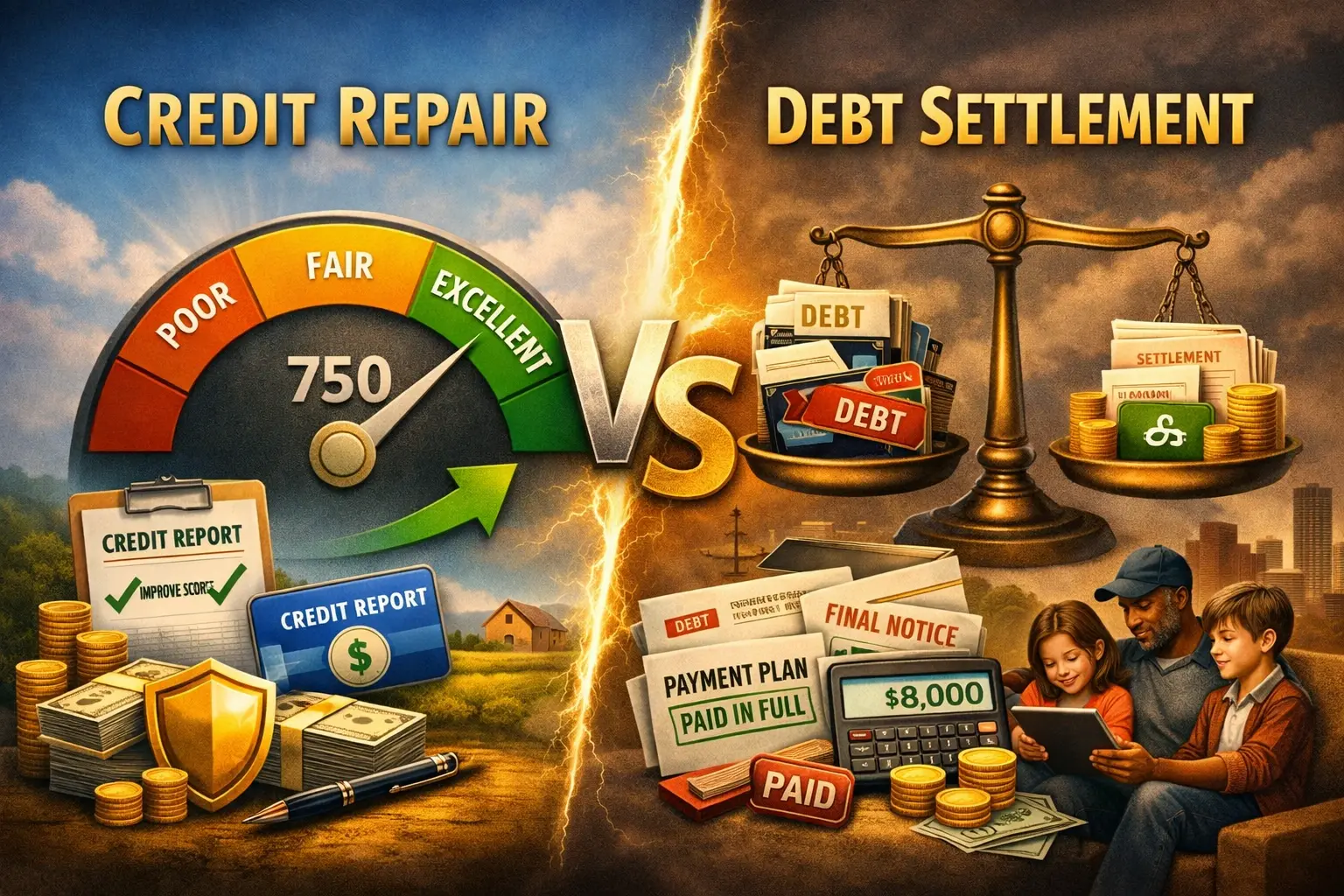
Millions of Americans are navigating damaged credit scores and mounting debt — often at the same time. When searching for a way out, two terms surface repeatedly: credit repair and debt settlement. They sound similar, and some companies blur the lines between them, but these are fundamentally different financial strategies with very different outcomes, costs, and consequences.
Making the wrong choice can deepen financial hardship rather than resolve it. According to the Consumer Financial Protection Bureau (CFPB), credit and consumer reporting complaints surpassed 2.5 million in 2024 alone — the most common issue being incorrect information appearing on credit reports. Meanwhile, debt settlement remains one of the most misunderstood financial tools available to consumers in serious financial distress.
This guide provides a clear, research-backed comparison of credit repair and debt settlement — what each actually does, how it impacts your credit, who qualifies, what it costs, and when each strategy makes sense.
Quick Answer
Credit repair is the process of identifying and disputing inaccurate, outdated, or unverifiable negative information on your credit reports to improve your credit score. It does not reduce debt balances.
Debt settlement is a negotiation strategy in which a creditor agrees to accept less than the full amount owed on a debt, typically as a lump-sum payment. It can reduce what you owe, but it significantly damages your credit score.
Feature | Credit Repair | Debt Settlement |
|---|---|---|
Goal | Improve credit score | Reduce debt owed |
How it works | Dispute errors on credit reports | Negotiate balance reduction with creditors |
Credit score impact | Positive (if errors removed) | Negative (score drops significantly) |
Debt reduction | No | Yes |
Timeline | 3–6 months typical | 2–4 years typical |
Tax consequences | None | Yes — forgiven debt may be taxable income |
Best for | Consumers with errors on reports | Consumers with severe, unmanageable debt |
Key Findings
A 2024 Consumer Reports study found that 44% of participants who checked their credit reports found at least one error — nearly double the rate found in the FTC's earlier research.
The CFPB received more than 2.5 million credit and consumer reporting complaints in 2024, with incorrect information on reports being the most common issue.
Debt settlement may reduce balances to roughly 50% of the amount owed, according to the American Association for Debt Resolution (AADR) — but the process can take 2–4 years.
Settled accounts are marked "Paid Settled" rather than "Paid in Full" on credit reports, and this notation can remain for up to seven years.
Forgiven debt over $600 is treated as taxable income by the IRS and reported on Form 1099-C.
A single 90-day late payment can drop a FICO score by up to 133 points, illustrating why credit repair — removing inaccurate derogatory marks — can have substantial financial value.
What Is Credit Repair?
Credit repair is a legal process governed by the Fair Credit Reporting Act (FCRA) and the Credit Repair Organizations Act (CROA). It involves reviewing credit reports from the three major bureaus — Equifax, Experian, and TransUnion — identifying errors or inaccurate negative entries, and formally disputing those items.
What Credit Repair Can Address
Accounts that do not belong to you (identity theft or mixed files)
Duplicate negative accounts
Incorrect account statuses (e.g., account listed as open when closed)
Outdated negative items past their legal reporting period
Incorrect balances, credit limits, or payment history
Collection accounts with inaccurate information
Fraudulent accounts opened without your consent
What Credit Repair Cannot Do
Credit repair cannot legally remove accurate, verifiable negative information. The CFPB explicitly warns consumers: "Beware of anyone who claims that they can remove information from your credit report that's current, accurate, and negative. It's probably a credit repair scam."
Legitimate credit repair works within the boundaries of consumer protection law. Any company promising to erase all negative marks — regardless of accuracy — is likely operating deceptively.
How the Credit Repair Process Works
Obtain credit reports from all three major bureaus (available free at AnnualCreditReport.com)
Review each report for errors, inaccuracies, or outdated items
Draft formal dispute letters citing specific FCRA provisions
Submit disputes to the credit bureaus and, when applicable, to the original data furnisher
Monitor results — bureaus are required to investigate within 30 days
Follow up on unresolved or rejected disputes with additional documentation
Professional credit repair companies handle this process on a consumer's behalf and often have experience escalating complex disputes. Resources and guidance on navigating the dispute process are available at creditrepairease.com.
What Is Debt Settlement?
Debt settlement is a debt relief strategy in which a consumer — or a debt settlement company acting on their behalf — negotiates with creditors to accept a reduced lump-sum payment in exchange for forgiving the remaining balance.
How Debt Settlement Works
Most debt settlement programs operate on a similar model:
Consumer stops making payments to creditors (to demonstrate financial hardship and build leverage)
Consumer deposits funds into a dedicated savings account over time
Once sufficient funds accumulate, the settlement company negotiates with creditors
Creditors accept a reduced settlement (typically 40–60% of the original balance)
The consumer pays the settled amount; the remaining balance is forgiven
What Debts Are Eligible
Debt settlement companies can generally only negotiate unsecured debt, including:
Credit card debt
Medical bills
Personal loans
Private student loans
Secured debt — mortgages, auto loans, or any debt backed by collateral — is typically not eligible. Back taxes and federal student loans also fall outside the scope of most debt settlement programs.
A minimum debt load of $7,500 to $10,000 is typically required to participate in a formal debt settlement program.
Credit Score Impact: A Critical Comparison
The credit score consequences of these two strategies diverge dramatically.
Credit Repair and Your Credit Score
Legitimate credit repair, when successful, has a positive effect on credit scores. When inaccurate negative items — late payments, collections, charge-offs — are removed from a credit report, scores typically increase. The magnitude of improvement depends on what was removed and what remains in the report.
The financial stakes are significant. FICO score simulations show that a single account reported as overdue by 90 days or more can reduce a score by up to 133 points. For someone with a $400,000 mortgage, a drop of that severity could increase the loan's annual percentage rate by more than half a point — adding $163 or more per month and over $58,000 over the life of the loan.
Debt Settlement and Your Credit Score
Debt settlement has a significantly negative impact on credit scores, often before a single debt is settled. Here is why:
Missed payments accumulate: Most settlement programs require consumers to stop paying creditors. Each missed payment is reported as delinquent and damages the credit score.
Delinquent accounts: Accounts that go unpaid for 30, 60, and 90+ days receive progressively worse marks.
"Settled" notation: Once a debt is settled, it appears as "Paid Settled" rather than "Paid in Full" — a distinction lenders view negatively.
Duration: Settled accounts can remain on credit reports for up to seven years from the original delinquency date.
Score drops of 100 points or more are common during the debt settlement process. Recovery is possible but slow, and depends on consistently responsible credit behavior following the settlement.
The Tax Consequences of Debt Settlement
One of the most overlooked risks of debt settlement is the tax liability it creates.
When a creditor forgives debt — meaning they accept less than the full balance — the forgiven amount is generally treated as taxable income by the IRS. If the forgiven balance is $600 or more, the creditor is required to file Form 1099-C (Cancellation of Debt Income) and send a copy to both the IRS and the consumer.
For example, if a consumer owes $20,000 on a credit card and settles for $10,000, the forgiven $10,000 may be reported as income. Depending on the consumer's tax bracket, this could create a tax bill of $1,200 to $3,700 or more on top of the settlement amount paid.
Certain exceptions apply — including insolvency and bankruptcy — but these require specific documentation and, in some cases, professional tax guidance.
Credit repair carries no tax consequences, as it involves correcting inaccurate records rather than reducing owed balances.
Cost Comparison
Credit Repair Costs
Credit repair companies typically charge monthly fees ranging from $69 to $149 per month, depending on the level of service. Some charge an initial setup fee as well. Consumers who handle the dispute process themselves pay only the cost of obtaining credit reports — which is free through AnnualCreditReport.com — and postage for written correspondence.
Debt Settlement Costs
Debt settlement companies charge fees based on one of two models:
Percentage of enrolled debt: Typically 15–25% of the total debt enrolled in the program
Percentage of forgiven debt: Typically 15–25% of the amount of debt that was forgiven
Clients who complete settlement programs pay approximately 50% of their enrolled balance before fees, or 65–85% including fees, according to industry data from Pacific Debt Relief. Programs typically run 24 to 48 months in duration.
Additionally, consumers may face legal action from creditors during the settlement period — since they are deliberately not paying their accounts — which can result in judgments, wage garnishment, or additional court costs.
Which Option Is Right for You?
The right strategy depends entirely on your financial circumstances.
Credit Repair May Be Right for You If:
Your credit reports contain errors, outdated items, or accounts you do not recognize
Your debt is manageable, but your credit score is holding back loan approvals or interest rates
You have been a victim of identity theft or fraud
You want to improve your credit score to qualify for a mortgage, auto loan, or apartment
Your negative items are inaccurate and disputable under the FCRA
Debt Settlement May Be Right for You If:
You have substantial unsecured debt (typically $10,000+) that you cannot realistically repay
You are already significantly behind on payments or in collections
You are facing a choice between settlement and bankruptcy
You understand and accept the credit score damage and potential tax consequences
You have the financial ability to fund a dedicated savings account over 2–4 years
Can You Pursue Both?
In some cases, consumers may benefit from sequential strategies — addressing errors on credit reports through credit repair while also managing unmanageable debt through settlement or another relief option. However, the timing matters: pursuing credit repair during an active debt settlement program can be complicated, as new derogatory marks are continuously being added to the report.
Consumers with questions about which strategy fits their situation can speak with a qualified credit specialist at (888) 803-7889 for guidance.
Research Insights: The Accuracy Crisis in Consumer Credit Reporting
The case for credit repair is increasingly supported by data showing the scale of the credit reporting accuracy problem in the United States.
Research findings from 2024 reveal that nearly half of consumers who reviewed their credit reports found at least one error — a rate that has grown substantially over the past decade. In Q1 of 2025, CFPB complaint volume crossed one million in a single quarter for the first time, with credit reporting accounting for 81% of all complaints filed.
Industry data from Bridgeforce Data Solutions indicates that 15–25% of trade lines submitted to credit bureaus without automated quality controls contain errors. These are not edge cases; they are systemic failures in a data infrastructure that directly determines whether millions of Americans can access affordable credit, housing, or employment.
At the same time, credit bureau dispute resolution practices have come under renewed scrutiny. From early to late 2025, TransUnion's consumer relief rate on disputes declined by 50%, and Experian's share fell from 20% in 2024 to less than 1% in 2025, according to reporting from CNBC Select. This makes professional advocacy through credit repair increasingly valuable for consumers with legitimate disputes.
For consumers facing both credit report errors and debt challenges, understanding the regulatory landscape is essential — and resources like creditrepairease.com offer guidance on navigating both.
Frequently Asked Questions
1. What is the main difference between credit repair and debt settlement?
Credit repair focuses on correcting inaccurate or unverifiable negative information on your credit reports to improve your credit score. Debt settlement focuses on negotiating with creditors to reduce the actual amount of debt you owe. They address different problems — one targets your credit history, the other targets your outstanding balances.
2. Does debt settlement hurt your credit score?
Yes, significantly. Debt settlement typically involves stopping payments to creditors, which results in late payment and delinquency marks on your credit report. Once settled, accounts are marked "Settled" rather than "Paid in Full" — a negative notation that can remain on your report for up to seven years. Score drops of 100 points or more are common.
3. Can credit repair remove legitimate negative items?
No. Credit repair can only legally remove inaccurate, outdated, or unverifiable information. Accurate negative items — such as a genuine late payment or a legitimately charged-off account — cannot be disputed or removed. Anyone claiming otherwise is likely running a scam.
4. Is forgiven debt taxable?
Generally, yes. When a creditor forgives $600 or more in debt, the IRS treats that forgiven amount as taxable income. The creditor is required to issue Form 1099-C, and the consumer must report the forgiven amount on their tax return. Exceptions exist for insolvency and bankruptcy situations.
5. How long does credit repair take?
Results vary depending on what is being disputed and the responsiveness of the credit bureaus. Credit bureaus have 30 days to investigate most disputes. Many consumers see movement within 45–90 days, though complex cases or multiple disputes can take 6 months or longer to resolve fully.
6. How long does debt settlement take?
Debt settlement programs typically run 24 to 48 months, though some extend longer. The timeline depends on the total amount of debt, the consumer's ability to save funds for settlements, and how quickly individual creditors agree to negotiate.
7. What types of debt can be settled?
Debt settlement applies primarily to unsecured debt — credit cards, medical bills, personal loans, and some private student loans. Secured debt such as mortgages and auto loans is generally not eligible. Back taxes and federal student loans also typically fall outside the scope of standard debt settlement programs.
8. Can I do credit repair myself?
Yes. Consumers have the legal right to dispute errors on their credit reports directly with the credit bureaus at no cost. The process involves obtaining your reports, identifying errors, and submitting written disputes. Professional credit repair companies handle this process on your behalf, often with more experience navigating complex or high-volume disputes.
9. Is debt settlement better than bankruptcy?
Neither option is clearly superior — it depends on the individual's financial situation. Bankruptcy provides broader legal protection and can discharge more types of debt, but has more severe and longer-lasting credit consequences. Debt settlement is less formal and may resolve a portion of debt without a legal proceeding, but carries significant credit damage and potential tax liability.
10. What should I do if I have both credit errors and too much debt?
Speak with a qualified credit or financial professional before choosing a strategy. In some cases, a combination of approaches may be appropriate — but the sequencing and execution matter. A specialist can help you assess which option, or combination of options, fits your specific financial profile.
Conclusion
Credit repair and debt settlement are not interchangeable — they solve different problems, operate through different mechanisms, and produce very different outcomes for your financial health.
If your primary challenge is an inaccurate or damaged credit report standing between you and better rates, housing, or credit access, credit repair is the appropriate tool. If you are drowning in unsecured debt with no realistic path to repayment, debt settlement — with its trade-offs fully understood — may be a legitimate last resort before bankruptcy.
The worst outcome for most consumers is selecting the wrong tool for the wrong problem, or being misled by companies that overpromise results in either category. Informed decision-making, grounded in the facts of your own financial situation, is the most valuable first step.
For questions about credit repair services and whether your situation may benefit from professional dispute assistance, visit creditrepairease.com or call (888) 803-7889 to speak with a specialist.
📚More About Credit Repair

How Long Before Buying a Home Should You Start Credit Repair?
June 30, 2026
What Happens During a Credit Repair Consultation?
June 9, 2026
Credit Repair vs. Credit Counseling: Which Is Right for You?
May 19, 2026