What Happens During a Credit Repair Consultation?
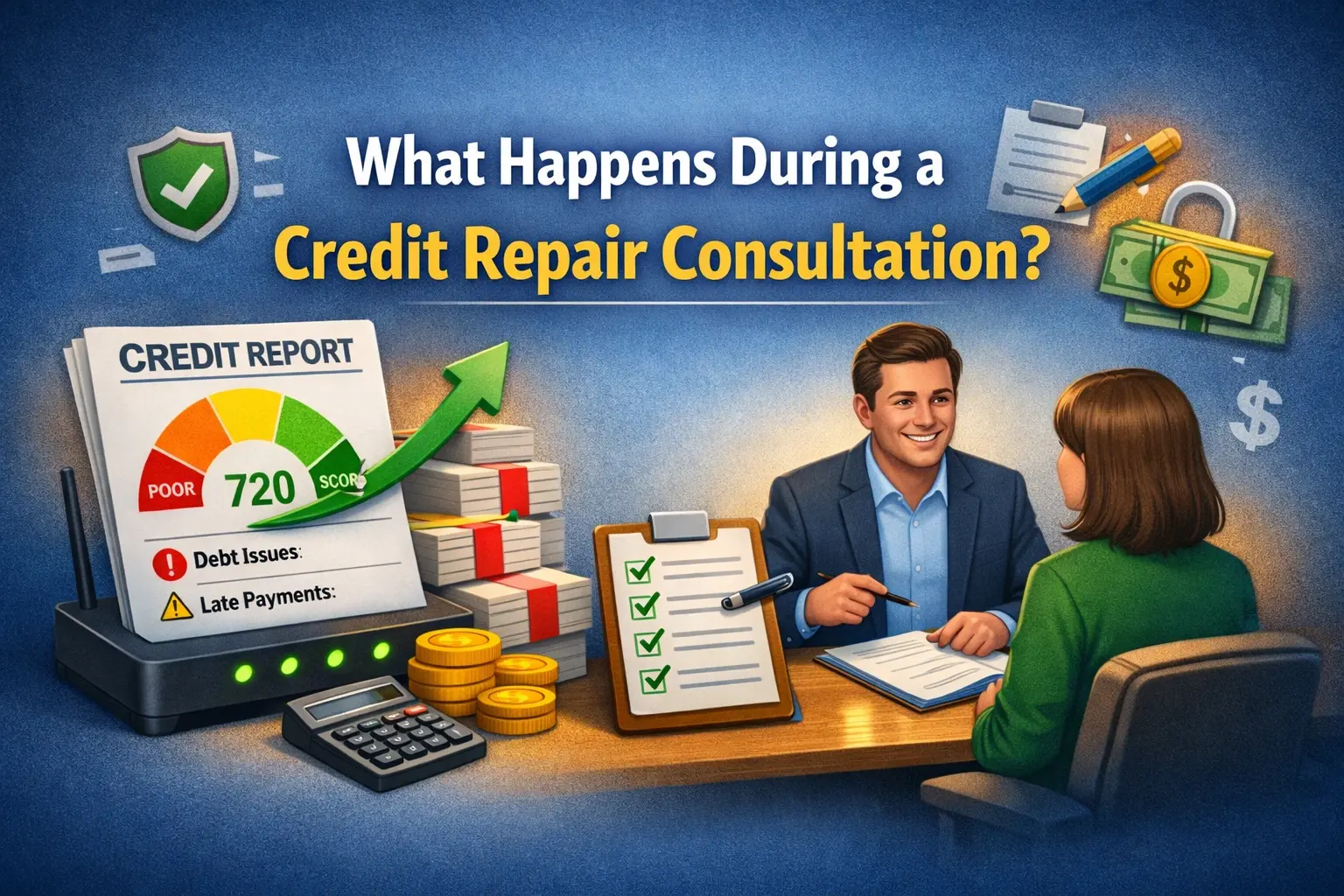
A credit repair consultation is a structured review session — typically 30 to 60 minutes — in which a credit specialist pulls and analyzes your three credit reports from Equifax, Experian, and TransUnion, identifies inaccurate, outdated, or unverifiable negative items, explains your rights under the Fair Credit Reporting Act (FCRA), and outlines a personalized dispute and credit-building strategy. Most consultations are offered at no charge. The goal is not to sell a service on the spot — it is to give you an honest, detailed picture of what your credit report contains, what can realistically be addressed, and what the process will look like.
Key Findings at a Glance
Consultation Component | Typical Duration | What You Learn |
|---|---|---|
Credit report pull (all 3 bureaus) | 5–10 minutes | Baseline scores, account summary |
Negative item identification | 10–15 minutes | Which items are disputable vs. accurate |
FCRA rights review | 5–10 minutes | What the law entitles you to dispute |
Dispute strategy outline | 10–15 minutes | Priority order, expected timeline |
Credit-building recommendations | 5–10 minutes | Payment habits, utilization, and new accounts |
Q&A and next steps | 5–10 minutes | Service terms, fees, and what happens after |
Total | 30–60 minutes | Complete picture of your credit situation |
Introduction
For many people, the idea of a credit repair consultation carries uncertainty. What exactly will they look at? What questions will they ask? Will I be pressured to sign something? Is this going to cost me money before anything even happens?
These are reasonable questions — and they deserve direct answers, because the quality of a credit repair consultation is often the clearest signal of whether the company providing it is worth working with.
The credit landscape in 2025 and 2026 makes this evaluation more important than ever. The CFPB received more than 5.6 million consumer complaints in the 18 months ending June 2025, with nearly 4.8 million — the vast majority — related to credit and consumer reporting. Credit reporting complaints increased by 182% in 2024 compared to the prior two-year monthly average, and the most common issue, by a significant margin, was incorrect information appearing on consumer reports. At the same time, enforcement resources at the CFPB were significantly reduced in early 2025, leaving consumers more reliant on professional advocacy and their own understanding of FCRA rights than at any point in recent years.
This guide explains exactly what happens during a legitimate credit repair consultation, what you should bring, what questions to ask, what red flags to watch for, and how to use the information you receive — whether or not you ultimately engage a paid service.
What Is a Credit Repair Consultation?
A credit repair consultation is an initial assessment session between a consumer and a credit specialist. It functions similarly to a first appointment with a financial advisor or attorney: the goal is to understand your situation, explain the relevant legal framework, and give you enough information to make an informed decision about your next steps.
Legitimate consultations are typically offered free of charge. Under the Credit Repair Organizations Act (CROA) — the federal law governing credit repair companies — providers are prohibited from charging fees before services are performed. A consultation that requires upfront payment before pulling your reports or providing any analysis is a compliance red flag.
The consultation is not a commitment. It does not obligate you to purchase a service, sign a contract, or take any action. Its purpose is information exchange: you provide access to your credit history; the specialist provides an expert assessment of what that history contains and what can be done about it.
The 7 Stages of a Credit Repair Consultation
Stage 1: Identity Verification and Authorization
Before reviewing your credit reports, the consultant will verify your identity and — if they are pulling reports on your behalf — obtain signed authorization to do so. This is a legal requirement, not a formality.
You will typically provide:
Government-issued photo ID (driver's license or passport)
Proof of address (a utility bill, bank statement, or lease dated within the past 60–90 days)
Social Security number (for identity verification with the credit bureaus)
If the consultant is directing you to pull your own reports through AnnualCreditReport.com — which provides free weekly access to all three bureau reports — authorization is not required since you are accessing your own information directly.
Stage 2: Pulling Your Three-Bureau Credit Reports
The foundation of any credit repair consultation is a current, complete view of all three credit reports: Equifax, Experian, and TransUnion. Each bureau operates independently, and the information they hold can differ significantly from one another. An account that appears as a collection on one report may not appear on the others. A late payment that has passed its seven-year reporting window on one bureau may still appear on another.
A professional consultant will pull what is called a tri-merge report — a consolidated view of all three bureaus — which allows side-by-side comparison of how the same accounts are reported across each source.
What your credit reports contain:
Personal identifying information (name, address, date of birth, Social Security number)
Account history (credit cards, loans, mortgages, auto loans)
Payment history for each account
Current balances and credit limits
Negative items (late payments, collections, charge-offs, judgments, bankruptcies)
Public records
Hard and soft credit inquiries
Account age and mix
Why all three bureaus matter: FICO scores used in 90% of lending decisions are calculated separately by each bureau. A consumer might have a 640 score at Experian and a 595 score at TransUnion based on different information being reported. Disputing an error with only one bureau leaves the inaccuracy intact at the others.
Stage 3: Credit Report Analysis — Identifying Disputable Items
This is the most substantive stage of the consultation and the one that most directly determines whether a paid credit repair service will deliver value for your specific situation.
The consultant will review every negative item on your report and classify each one according to a fundamental distinction that defines the entire credit repair process:
Category A — Potentially disputable items:
Accounts that do not belong to you (possible identity theft or mixed file errors)
Duplicate accounts appearing more than once
Accounts listed as open that are closed, or vice versa
Incorrect balances, credit limits, or payment statuses
Late payments were reported for months when payments were made on time
Collections for debts you have already paid or that have passed the statute of limitations
Negative items that have exceeded their legal reporting window (7 years for most derogatory items; 10 years for Chapter 7 bankruptcy under FCRA Section 605)
Personal information errors (wrong address, name misspellings, incorrect Social Security number)
Accounts opened fraudulently in your name
Category B — Items that cannot be removed through dispute:
Accurately reported late payments within the 7-year window
Valid collections on debts you legitimately owe
Verified bankruptcies within their legal reporting period
Hard inquiries from credit applications you authorized
The CFPB's 2024 Annual Report confirmed that incorrect information on credit reports was the most common consumer complaint the agency received — specifically citing inaccuracies involving credit inquiries, account and payment statuses, bankruptcies, and personal information. A 2025 Credit Saint analysis of this CFPB data noted that more than half of credit reporting complaints that received a substantive response resulted in companies providing some form of relief, including corrections to the consumer's report.
An honest consultant will be clear about which category each item on your report falls into. If every item on your report is being classified as "disputable" regardless of whether it is accurate and verifiable, that is a significant red flag.
Stage 4: Your FCRA Rights — What the Law Entitles You to Do
A quality consultation includes a plain-language explanation of the federal consumer rights that govern the credit dispute process. Understanding these rights before agreeing to any paid service is essential.
The Fair Credit Reporting Act (FCRA), 15 U.S.C. § 1681 et seq., is the primary law governing credit reporting. Key consumer rights under the FCRA include:
The right to a free credit report — Consumers can access free weekly reports from all three bureaus at AnnualCreditReport.com, a benefit extended in 2022 and maintained through 2025.
The right to dispute inaccurate information — You may dispute any item you believe is inaccurate directly with the credit bureau, and the bureau must investigate within 30 days (extendable only with consumer consent). This right is unchanged by the 2025 regulatory environment.
The right to dispute with furnishers — You may also dispute directly with the creditor or collection agency that provided the information, not only with the bureau.
The right to a description of the investigation — If a dispute results in no change, you can request a description of the investigation conducted.
The right to add a consumer statement — You may add a 100-word explanation to your credit file that will appear alongside disputed items.
The right to sue for violations — If a bureau or furnisher violates FCRA requirements, you have the right to sue in federal court. FCRA litigation rose 12.6% year-over-year from 2024 to 2025, reflecting growing awareness of this remedy.
The Credit Repair Organizations Act (CROA) governs companies that offer credit repair services for a fee. Key consumer protections include:
No fees before services are performed
A mandatory 3-day right of cancellation after signing a contract
A written contract is required before any services begin
Prohibition on false representations about services provided
A consultant who does not mention CROA protections — or who pressures you to waive the cancellation right — is operating outside legal standards.
Stage 5: The Dispute Strategy and Action Plan
Based on the report analysis, the consultant will outline a prioritized dispute and credit-building plan tailored to your specific situation. This is where a professional consultation adds genuine value beyond what you can obtain from a single credit report pull.
A well-constructed dispute plan includes:
Prioritization by impact: Not all negative items affect your score equally. A collection account on a high-balance debt has more score impact than a single 30-day late payment from six years ago. A good consultant identifies which removals would produce the most meaningful score improvement and sequences the dispute strategy accordingly.
Bureau-specific strategy: Because bureaus investigate disputes independently, the approach to challenging an item at Experian may differ from the approach at TransUnion. Experienced consultants know which types of supporting documentation are most effective at each bureau and how to structure disputes that are less likely to be dismissed as frivolous.
Timeline expectations: Under the FCRA, credit bureaus have 30 days to investigate a dispute after receiving it (15 U.S.C. § 1681i). This means the first round of results typically arrives 30 to 45 days after disputes are submitted. The average consumer completes the credit repair process in 3 to 6 months, according to Debt.com research, though complex cases involving multiple derogatory items, identity theft, or mixed credit files can take 9 to 12 months.
Interim score-building actions: Dispute resolution is only one component of credit improvement. The consultant should also address credit utilization (keeping revolving balances below 30% of credit limits), payment history going forward, account mix, and — where appropriate — strategic use of secured credit cards or credit-builder loans to add positive reporting history.
Stage 6: The Honest Assessment — What Can and Cannot Be Achieved
This stage separates legitimate credit repair consultants from predatory ones.
Credit repair is not a method for erasing accurate, verified negative information. A bankruptcy that occurred four years ago and is accurately reported will remain on your report until the 10-year window closes, regardless of how many disputes are filed. A late payment from 18 months ago that is accurately documented cannot be legally removed — though a goodwill letter to the creditor, a separate strategy from formal disputing, may sometimes succeed.
What credit repair can legitimately achieve:
Removal of inaccurate negative items
Correction of reporting errors (wrong balances, wrong payment status, wrong account ownership)
Deletion of items past their legal reporting window
Resolution of identity theft or mixed file errors
Removal of unverifiable items that bureaus and furnishers cannot substantiate
What credit repair cannot legitimately achieve:
Permanent removal of accurate, timely, and verifiable negative information
Creation of a new credit identity (a practice known as "credit washing" or using CPNs — Credit Privacy Numbers — that is illegal under federal law)
Guaranteed score increases by a specific date
A consultant who promises guaranteed score increases, claims they can remove any item regardless of accuracy, or suggests using a new Social Security number or CPN to start fresh is describing illegal practices. These are not aggressive tactics — they are federal crimes under the Identity Theft Enforcement and Restitution Act.
Stage 7: Next Steps, Fees, and the Decision Framework
The final stage of the consultation covers the practical terms of engaging a professional service, if that is your decision.
What to ask about fees:
Is there a setup or first-work fee, and what does it cover?
What is the monthly fee, and what services does it include each month?
Is billing based on items disputed, items deleted, or a flat monthly rate?
Are there any charges if no progress is made in a given month?
Credit repair companies typically charge between $50 and $150 per month for ongoing dispute management, plus an initial setup fee of similar magnitude, according to Money.com's 2026 analysis of the credit repair industry. Pay-per-deletion models — where fees are charged only when a negative item is successfully removed — exist and may be preferable depending on your situation, as they align the company's incentive directly with your results.
Your mandatory rights at this stage:
You have the right to a written contract before any work begins
You have the right to cancel within 3 business days of signing without penalty
No payment should be collected before the cancellation period ends
The self-help alternative: Everything a credit repair company does on your behalf, you are legally entitled to do yourself at no cost. The FCRA grants consumers direct dispute rights with all three bureaus. The question is not whether you can do it — it is whether the complexity of your situation, the time required, and the strategic expertise involved make professional assistance worth the cost.
For consumers with a single disputed item and straightforward circumstances, DIY disputing through AnnualCreditReport.com and the bureaus' online dispute portals may be sufficient. For consumers with multiple negative items across bureaus, identity theft complications, or upcoming credit-sensitive events like a mortgage application, professional assistance often accelerates results meaningfully.
What to Bring to Your Credit Repair Consultation
Being prepared for your consultation improves the quality of the assessment and reduces the time spent on administrative steps.
Documents to bring:
Government-issued photo ID — Driver's license, state ID, or passport
Proof of address — Recent utility bill, bank statement, or lease (within 60–90 days)
Social Security card or documentation — For identity verification
Your most recent credit reports — If you have pulled them yourself within the past 30 days, bringing copies saves time (available free at AnnualCreditReport.com)
Documentation of disputed items — If you already know of specific errors, bring any supporting evidence: payment receipts, account statements, correspondence with creditors, settlement letters, or identity theft reports filed with the FTC
Information to have ready:
Your current monthly income (relevant for debt-to-income discussions)
A list of any accounts you believe are incorrect or do not recognize
Any recent correspondence from debt collectors
Your credit goals and timeline (e.g., "I'm applying for a mortgage in 8 months")
Having your goals defined before the consultation allows the specialist to build a strategy around a specific outcome — which produces a more actionable plan than a general credit improvement discussion.
Research Insights: The Changing Landscape of Credit Dispute Resolution
The credit repair consultation is not happening in a static environment. The dispute landscape has shifted significantly in the past two years in ways that directly affect what a professional credit repair engagement can achieve and why some consumers are finding it harder to resolve errors independently.
CFPB Enforcement Pullback and Bureau Dispute Resolution Rates
In early 2025, following the change in federal administration, the CFPB was significantly reduced in capacity. The acting director ordered a halt to nearly all active agency work, investigations were frozen, and an enforcement action against TransUnion that had been approved in July 2024 was never filed. The practical consequence for consumers became visible within months.
In March 2026, ProPublica published an in-depth analysis showing that two of the three major credit reporting agencies — TransUnion and Experian — had sharply reduced the rate at which they resolve disputes in consumers' favor. Experian resolved nearly one in five consumer complaints in the consumer's favor in 2024; in 2025, that figure dropped to less than one percent. TransUnion's relief rate, which had held steady for years, fell sharply in mid-2025. Since January 2025, more than 2.7 million credit reporting complaints filed with the CFPB have gone without any relief provided to the consumer.
The Equifax exception is instructive: just before the administration change, Equifax entered into a $15 million consent order with the CFPB requiring it to overhaul its dispute process and remain compliant for five years. That order created an enforceable compliance obligation that remained in effect regardless of the shift in CFPB enforcement posture — which helps explain why Equifax dispute resolution rates did not show the same decline.
The FCRA itself has not changed. The 30-day investigation requirement, the right to dispute, and the right to sue for violations remain fully in effect. What has changed is the enforcement architecture that previously ensured bureaus followed through on those obligations. This environment makes professional advocacy — by firms with established processes, documentation practices, and willingness to escalate legally — more valuable than it was during periods of stronger regulatory oversight.
FCRA Litigation as a Consumer Remedy
FCRA lawsuits rose 12.6% year-over-year from 2024 to 2025, according to WebRecon data analyzed by Bridgeforce Data Solutions. The total number of FCRA-related civil suits filed in 2024 and 2025 represents a decade-long trend, with total FCRA litigation up 147% since 2014.
For consumers whose disputes are being ignored or rubber-stamped — a documented pattern as of 2025–2026 — the FCRA's private right of action is a meaningful remedy. Credit repair companies with attorneys on staff or legal referral relationships are better positioned to pursue this avenue than individual consumers navigating it alone. This is a factor worth raising during a consultation if your situation involves items that have been repeatedly disputed without resolution.
Red Flags to Watch For During a Credit Repair Consultation
The credit repair industry includes both legitimate, compliance-focused companies and predatory actors. Knowing what to watch for protects consumers from services that will take fees without delivering results — or, worse, expose them to legal liability.
Immediate red flags:
Upfront fees before any work is performed — Illegal under CROA
No written contract offered — Required by law before services begin
Claims to remove any negative item regardless of accuracy — Not legally possible for verified, accurate items
Suggestion to use a new Social Security number, EIN, or CPN — A federal crime
Guarantees of specific score increases — No legitimate company can guarantee credit score outcomes
Pressure to sign immediately without a review period — You have a 3-day cancellation right and should be encouraged to use it
No mention of your right to dispute independently — Reputable companies explain that FCRA rights belong to you regardless of whether you hire help
Vague explanations of what they will actually do — You should receive a clear description of specific services before signing
Structural red flags:
The company cannot explain the FCRA or CROA by name
The consultant does not distinguish between disputable and non-disputable items
No timeline or realistic outcome range is provided
The company discourages you from accessing your own credit reports independently
Consumer Impact: Why the Consultation Matters Beyond the First Appointment
The credit repair consultation is not only about the information gathered during a 30-to-60-minute session. It establishes the baseline against which all subsequent progress will be measured, and it shapes the strategy that determines how effective the repair process will be.
For consumers preparing for major financial decisions, the consultation timeline matters directly. A consumer planning to apply for a mortgage in 8 months needs to know — within the next few weeks — whether errors exist that can be disputed and resolved within that window, whether score improvement is realistically achievable given their current profile, and what credit-building actions should begin immediately to maximize the score at the time of application. A consultation that produces a vague "we'll work on your credit" commitment rather than a specific timeline and strategy is not sufficient preparation.
For consumers dealing with identity theft, the consultation is often the first structured assessment of the full scope of the damage. Identity theft can result in fraudulent accounts appearing across multiple bureaus, legitimate accounts being misreported due to mixed files, and collections for debts the consumer never incurred. A tri-merge report review is the only way to see the complete picture — and professional guidance on the FTC Identity Theft Report process, Section 605B of the FCRA (which entitles identity theft victims to block fraudulent information), and the legal remedies available is genuinely valuable.
For consumers in markets where credit access affects housing, employment, and insurance, the stakes are not abstract. Landlords, employers, and insurance companies all use credit data in ways that affect everyday life. The Experian resolution rate dropping from nearly 20% in 2024 to less than 1% in 2025 is not a regulatory footnote — it is a real change in the practical availability of error correction through standard bureau dispute channels, and it has direct consequences for consumers trying to correct their records.
Frequently Asked Questions
Is a credit repair consultation free?
Most legitimate credit repair companies offer a free initial consultation. Under the Credit Repair Organizations Act (CROA), credit repair providers cannot charge fees before services are performed, which means any company requiring payment before reviewing your credit reports or providing analysis is violating federal law. A free consultation is both the industry standard and a legal baseline expectation.
How long does a credit repair consultation last?
A thorough credit repair consultation typically takes 30 to 60 minutes. Shorter sessions may not allow adequate time to review all three credit reports in detail, identify all disputable items, and explain your FCRA rights and next steps. If a consultation is completed in under 15 minutes, it likely did not include a meaningful report analysis.
What does a credit repair consultant actually look at?
The consultant reviews your three-bureau credit reports from Equifax, Experian, and TransUnion, looking specifically for inaccurate, outdated, unverifiable, or fraudulent information. They analyze payment history, account statuses, collection accounts, charge-offs, public records, and personal information for errors. They also assess your credit utilization, account age, and credit mix to identify credit-building opportunities beyond dispute filing.
What is the difference between items that can and cannot be removed?
Under the FCRA, credit bureaus are required to report accurate information for the periods set by law — seven years for most derogatory items, ten years for Chapter 7 bankruptcy. Items that are accurately reported within these windows cannot be legally removed through dispute. Items that can be removed include those that are inaccurate, unverifiable, belong to someone else, duplicate existing entries, or have exceeded their legal reporting window. A legitimate consultant clearly distinguishes between these categories.
Do I need to bring anything to a credit repair consultation?
Yes. Bring a government-issued photo ID, proof of your current address (utility bill or bank statement dated within 60–90 days), and your Social Security card or documentation. If you have recently pulled your own credit reports or have documentation related to specific disputed items — payment receipts, settlement letters, correspondence from debt collectors — bringing those materials improves the quality of the analysis.
How soon can I expect to see results after starting credit repair?
The FCRA requires credit bureaus to investigate disputes within 30 days of receipt. The first results from an initial round of disputes therefore arrive approximately 30 to 45 days after filing. Debt.com research indicates the average consumer completes the credit repair process in 3 to 6 months, though cases involving multiple derogatory items, identity theft, or complex bureau disputes may require 9 to 12 months. Meaningful credit score improvement often follows the removal of major negative items — particularly collections and charge-offs — within one to three months of deletion.
Can I do credit repair myself instead of hiring a company?
Yes. The FCRA grants consumers the right to dispute inaccurate information directly with all three bureaus and with the companies that provided the information. You can access your free weekly credit reports at AnnualCreditReport.com and file disputes online, by mail, or by phone at no cost. Many people with straightforward situations — a small number of clearly identifiable errors — successfully handle disputes independently. Professional credit repair companies add value primarily through strategic expertise, bureau-specific dispute knowledge, legal escalation options, and time savings. The decision depends on the complexity of your situation and how much professional support your circumstances warrant.
What is the Credit Repair Organizations Act (CROA), and how does it protect me?
CROA is the federal law governing companies that offer credit repair services for payment. Its key consumer protections include: no fees before services are performed, a mandatory written contract before work begins, a 3-business-day right to cancel without penalty, and a prohibition on false representations about services. Any company that charges upfront fees, does not provide a written contract, discourages you from exercising your cancellation right, or makes guarantees it cannot deliver is violating CROA.
Conclusion
A credit repair consultation done properly is one of the more useful financial assessments a consumer with a damaged credit profile can undertake. It translates a complex, bureau-specific document — your credit report — into a prioritized action plan tied to real legal rights and realistic timelines.
The value of the consultation is not limited to whether you decide to engage a paid service afterward. Understanding what is on your credit report, distinguishing between what can and cannot be addressed, and knowing your FCRA rights are outcomes that benefit every consumer regardless of the path they choose.
The current environment — where credit bureau dispute resolution rates have dropped sharply at two of the three major bureaus, CFPB enforcement capacity has been substantially reduced, and FCRA litigation continues to rise — makes professional guidance more, not less, relevant than it was a few years ago. Consumers navigating the dispute process alone in this environment face a more challenging path than the law's text, taken in isolation, would suggest.
If you are considering a credit repair consultation and want to understand what your credit reports contain, what items may be disputable, and what a realistic improvement timeline looks like for your situation, creditrepairease.com provides access to experienced credit consultants who will walk through your reports with transparency and without obligation. You can also reach the consultation team directly at (888) 803-7889 to schedule a free review.
📚More About Credit Repair

How Long Before Buying a Home Should You Start Credit Repair?
June 30, 2026
Credit Repair vs. Debt Settlement: What's the Difference and Which One Do You Need?
June 2, 2026
Credit Repair vs. Credit Counseling: Which Is Right for You?
May 19, 2026