-
Posted on: 25 Feb 2026
-
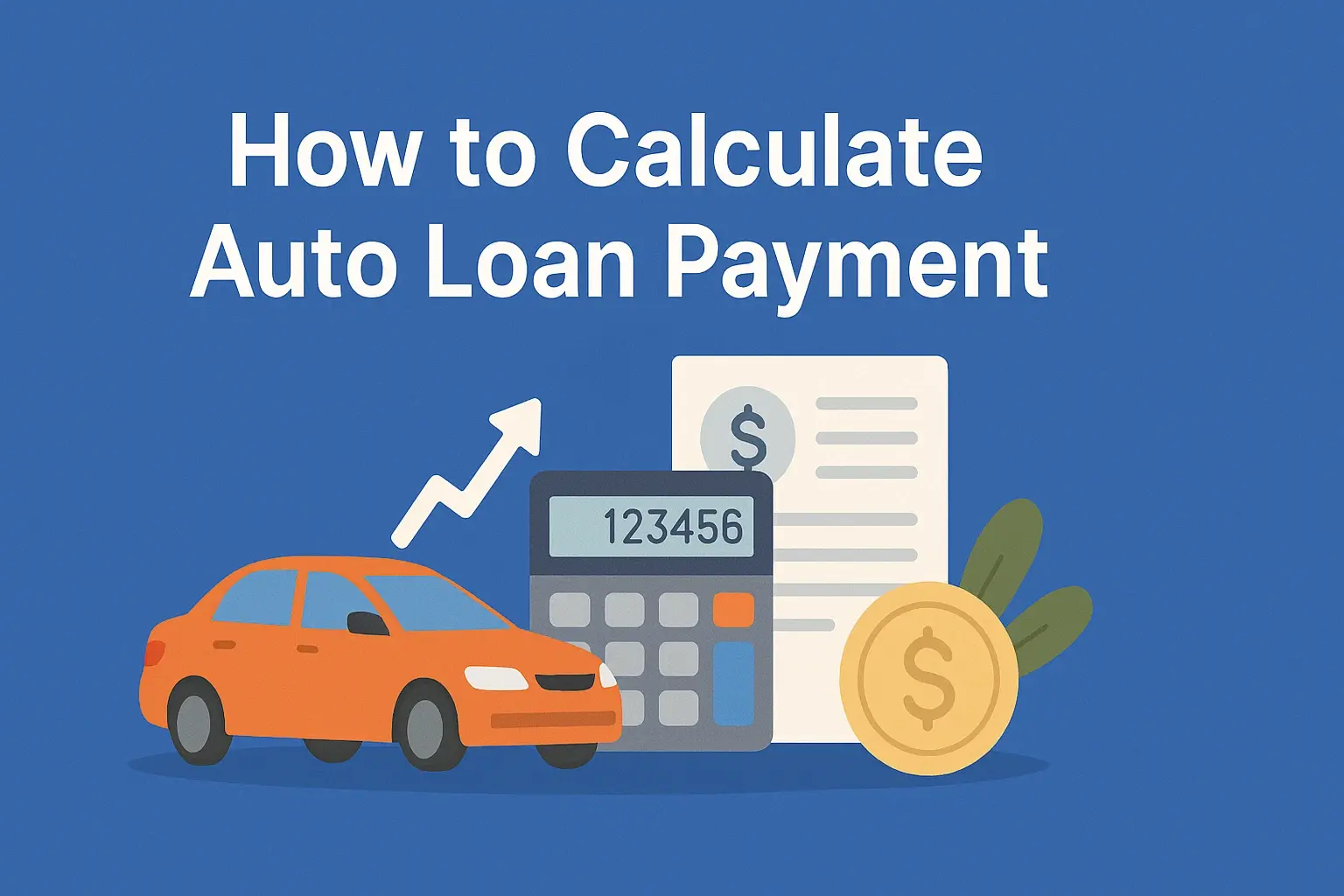
Understanding how to calculate your auto loan payment is crucial for budgeting and making informed financial decisions. This guide breaks down the essential formula and factors influencing your monthly car payment, empowering you to estimate costs accurately and negotiate effectively.
Understanding the Basics: The Auto Loan Payment Formula
Calculating your auto loan payment might seem daunting, but it boils down to a standard financial formula. The most common method used to determine the monthly payment for an amortizing loan, like an auto loan, is the annuity formula. This formula accounts for the principal amount borrowed, the interest rate, and the loan term.
The formula for calculating the monthly payment (M) is:
$$ M = P \left[ \frac{i(1+i)^n}{(1+i)^n - 1} \right] $$
Where:
M = Your monthly loan payment
P = The principal loan amount (the total amount you borrow for the car)
i = Your monthly interest rate (annual interest rate divided by 12)
n = The total number of payments (loan term in years multiplied by 12)
Let's break down each component to ensure clarity. The principal (P) is straightforward – it's the sticker price of the car minus any down payment or trade-in value. The loan term is the duration of the loan, typically expressed in years, which you'll convert to months for the calculation. The interest rate (i) is perhaps the most variable and impactful component, and it's crucial to convert the annual percentage rate (APR) into a monthly figure.
For example, if you have an annual interest rate of 6%, your monthly interest rate (i) would be 0.06 / 12 = 0.005.
The number of payments (n) is also straightforward. A 5-year loan term means 5 years * 12 months/year = 60 payments.
While this formula is the mathematical core, understanding the variables that feed into it is just as important for a complete picture of your auto loan costs.
The Annuity Formula Explained
The annuity formula is designed to ensure that each of your monthly payments is split between paying down the principal and covering the interest accrued. In the early stages of your loan, a larger portion of your payment goes towards interest, and as you progress through the loan term, more of your payment is applied to the principal. This is known as amortization.
The formula might look complex, but its purpose is to amortize the loan evenly over its life. It calculates a fixed payment that, when made consistently over the loan's term, will fully repay the principal and all the interest charged.
Key Takeaway: The annuity formula is the standard for calculating fixed monthly payments on amortizing loans. Understanding its components helps demystify your loan costs.
Key Factors Influencing Your Payment
Several elements directly affect how much you'll pay each month for your auto loan. Understanding these factors will not only help you calculate your payment but also guide you in negotiating better terms.
Principal Loan Amount (P)
This is the core of your loan. The higher the principal, the higher your monthly payments will be, assuming all other factors remain constant. The principal is determined by the car's price, minus any down payment you make, and the value of your trade-in vehicle.
2025-26 Data Point: The average new car price in late 2025 is projected to be around $48,000, while used car prices are showing more stability but still represent a significant investment. A larger down payment can significantly reduce your principal and, consequently, your monthly payment.
Interest Rate (APR)
The Annual Percentage Rate (APR) is the annual cost of borrowing money, expressed as a percentage. It includes not only the base interest rate but also certain fees associated with the loan. A lower APR means you'll pay less in interest over the life of the loan, resulting in lower monthly payments and a lower total cost.
2025-26 Data Point: Interest rates for auto loans in 2025-26 are expected to fluctuate based on Federal Reserve policy and economic conditions. While rates might remain elevated compared to historical lows, borrowers with excellent credit can still secure competitive APRs, potentially in the 5-7% range for new cars and 7-10% for used cars. Those with lower credit scores may face rates significantly higher, sometimes exceeding 15%.
Loan Term
The loan term is the length of time you have to repay the loan, typically measured in months or years. Common terms range from 36 to 84 months (3 to 7 years). A shorter loan term will result in higher monthly payments because you're paying off the principal faster. Conversely, a longer loan term will lower your monthly payments but will mean you pay more interest over the life of the loan.
2025-26 Data Point: While longer loan terms (like 72 or 84 months) are popular for making monthly payments more affordable, financial experts in 2025-26 continue to advise caution. These extended terms can lead to paying more in interest than the car is worth, especially as vehicles depreciate. For example, a 72-month loan might have a lower monthly payment than a 60-month loan, but the total interest paid will be substantially higher.
Fees and Other Charges
While the APR aims to capture most costs, some lenders might have additional fees, such as origination fees, late payment fees, or early repayment penalties. These aren't directly part of the monthly payment calculation using the standard formula, but can affect the overall cost of the loan and should be considered when comparing offers.
Key Takeaway: The principal amount, interest rate, and loan term are the primary drivers of your monthly auto loan payment. Managing these factors can significantly impact your financial commitment.
Step-by-Step Calculation Guide
Let's walk through how to calculate your auto loan payment using the annuity formula. We'll use a hypothetical scenario to make it concrete.
Step 1: Determine the Principal Loan Amount (P)
This is the total amount you need to borrow. Subtract your down payment and any trade-in value from the car's purchase price.
Car Price: $30,000
Down Payment: $5,000
Trade-in Value: $3,000
Principal (P) = $30,000 - $5,000 - $3,000 = $22,000
Step 2: Determine the Loan Term in Months (n)
Decide on the loan term (e.g., 60 months or 5 years).
Loan Term: 5 years
Number of Payments (n) = 5 years * 12 months/year = 60
Step 3: Determine the Monthly Interest Rate (i)
Convert the annual interest rate (APR) to a monthly rate. If the APR is 7.5%, then:
Annual Interest Rate: 7.5% or 0.075
Monthly Interest Rate (i) = 0.075 / 12 = 0.00625
Step 4: Plug the Values into the Formula
Now, substitute your values into the annuity formula:
$$ M = P \left[ \frac{i(1+i)^n}{(1+i)^n - 1} \right] $$
$$ M = 22000 \left[ \frac{0.00625(1+0.00625)^{60}}{(1+0.00625)^{60} - 1} \right] $$
Step 5: Calculate the Result
Let's break down the calculation:
Calculate (1+i)^n: (1 + 0.00625)^60 = (1.00625)^60 ≈ 1.453297
Calculate the numerator: i * (1+i)^n = 0.00625 * 1.453297 ≈ 0.0090831
Calculate the denominator: (1+i)^n - 1 = 1.453297 - 1 = 0.453297
Calculate the fraction: 0.0090831 / 0.453297 ≈ 0.020038
Multiply by the principal: M = 22000 * 0.020038 ≈ 440.84
Your estimated monthly payment is approximately $440.84.
Online Calculators: While understanding the formula is valuable, most people use online auto loan calculators. These tools perform the same calculation instantly, allowing you to easily adjust variables like the loan amount, interest rate, and term to see how they affect your payment.
Key Takeaway: By systematically identifying your principal, loan term, and interest rate, you can accurately calculate your estimated monthly auto loan payment.
Real-World Examples (2025-26)
Let's explore how different scenarios, reflecting current market conditions for 2025-26, impact auto loan payments.
Example 1: New Car with Good Credit
Scenario: A borrower with excellent credit (760+ FICO score) is purchasing a new car with a sticker price of $40,000. They plan to make a $6,000 down payment and have a $4,000 trade-in value. They are looking at a 60-month loan term.
Car Price: $40,000
Down Payment: $6,000
Trade-in Value: $4,000
Principal (P): $40,000 - $6,000 - $4,000 = $30,000
Loan Term (n): 60 months
Estimated APR (for excellent credit in 2025-26): 6.5%
Monthly Interest Rate (i): 0.065 / 12 = 0.005417
Using the formula or an online calculator:
$$ M = 30000 \left[ \frac{0.005417(1+0.005417)^{60}}{(1+0.005417)^{60} - 1} \right] $$
Estimated Monthly Payment: Approximately $591.14
In this scenario, the borrower secures a favorable interest rate due to their strong credit, making the monthly payments manageable for a new vehicle.
Example 2: Used Car with Average Credit
Scenario: A borrower with an average credit (660-700 FICO score) is buying a used car priced at $20,000. They have a $2,000 down payment and no trade-in. They opt for a 72-month loan term to lower monthly costs.
Car Price: $20,000
Down Payment: $2,000
Trade-in Value: $0
Principal (P): $20,000 - $2,000 - $0 = $18,000
Loan Term (n): 72 months
Estimated APR (for average credit in 2025-26): 9.5%
Monthly Interest Rate (i): 0.095 / 12 = 0.007917
Using the formula or an online calculator:
$$ M = 18000 \left[ \frac{0.007917(1+0.007917)^{72}}{(1+0.007917)^{72} - 1} \right] $$
Estimated Monthly Payment: Approximately $311.35
Here, the longer loan term helps reduce the monthly payment, but the higher interest rate means this borrower will pay significantly more in interest over the life of the loan compared to Example 1.
Example 3: Car with Higher Interest Rate (Lower Credit Score)
Scenario: A borrower with a lower credit score (below 620) is looking at a $25,000 car. They have a $3,000 down payment and a $1,000 trade-in. They chose a 60-month term.
Car Price: $25,000
Down Payment: $3,000
Trade-in Value: $1,000
Principal (P): $25,000 - $3,000 - $1,000 = $21,000
Loan Term (n): 60 months
Estimated APR (for lower credit in 2025-26): 16.0%
Monthly Interest Rate (i): 0.160 / 12 = 0.013333
Using the formula or an online calculator:
$$ M = 21000 \left[ \frac{0.013333(1+0.013333)^{60}}{(1+0.013333)^{60} - 1} \right] $$
Estimated Monthly Payment: Approximately $519.03
This example highlights the substantial impact of a higher interest rate. Despite a similar principal and loan term to Example 1, the monthly payment is significantly higher, and the total interest paid will be considerably more.
2025-26 Market Insight: The average APR for new car loans in 2025 is projected to be around 6.8% for borrowers with excellent credit, while used car loans might average 10.5% for similar credit profiles. Subprime borrowers could face rates of 18% or more. These figures underscore the importance of credit health.
Key Takeaway: Real-world examples demonstrate that the interplay between loan principal, interest rate, and term can lead to vastly different monthly payments, especially in the 2025-26 lending environment.
Comparing Loan Offers: Beyond the Monthly Payment
While your calculated monthly payment is a critical figure, it's not the only metric to consider when evaluating auto loan offers. A comprehensive comparison involves looking at the total cost of the loan.
Total Interest Paid
This is the sum of all the interest you'll pay over the life of the loan. It's calculated by subtracting the principal loan amount from the total amount you'll repay.
Total Interest Paid = (Monthly Payment * Number of Payments) - Principal Loan Amount
A loan with a lower monthly payment might not necessarily be cheaper if it has a longer term and a higher interest rate, leading to more total interest paid.
Total Cost of the Loan
This is the principal amount plus the total interest paid. It represents the absolute amount of money you will spend to finance the car.
Total Cost of Loan = Principal Loan Amount + Total Interest Paid
Comparing the total cost across different loan offers gives you the clearest picture of which deal is financially superior.
Loan Fees and Other Costs
As mentioned earlier, be aware of any upfront fees (origination fees, documentation fees) or ongoing fees (late fees, early payoff penalties). These can add to the overall expense and should be factored into your decision. Always ask for a full breakdown of all costs associated with the loan.
Prepayment Penalties
Some loans charge a fee if you decide to pay off the loan early. If you anticipate making extra payments or paying the loan off ahead of schedule, ensure the loan does not have a prepayment penalty, or that the penalty is minimal.
Table Comparison of Loan Offers
Consider using a table to compare offers side-by-side:
Feature
Offer A (Dealer Financing)
Offer B (Credit Union)
Offer C (Online Lender)
Principal Loan Amount
$25,000
$25,000
$25,000
APR
7.0%
6.5%
6.8%
Loan Term
60 months
60 months
60 months
Estimated Monthly Payment
$495.06
$483.77
$489.41
Total Interest Paid
$4,703.60
$4,026.20
$4,364.60
Total Cost of Loan
$29,703.60
$29,026.20
$29,364.60
Origination Fee
$0
$150
$0
Prepayment Penalty
No
No
No
In this table, Offer B from the credit union has the lowest monthly payment and the lowest total cost, making it the most financially attractive option despite a small origination fee.
Key Takeaway: Always look beyond the monthly payment. Analyze the total interest paid and total cost of the loan to make the most financially sound decision.
The Impact of Your Credit Score on Payments
Your credit score is one of the most significant factors determining the interest rate you'll be offered on an auto loan. Lenders use your credit score to assess your risk as a borrower. A higher credit score indicates a lower risk, which typically translates into a lower APR.
2025-26 Credit Score Impact:
Excellent Credit (740+): Can expect APRs in the 5-7% range for new cars and 7-9% for used cars.
Good Credit (670-739): May see APRs around 7-9% for new cars and 9-12% for used cars.
Fair Credit (580-669): APRs can range from 10-15% for new cars and 12-18% for used cars.
Poor Credit (Below 580): May face APRs of 15% and significantly higher, sometimes exceeding 20%, especially for used vehicles.
The difference in interest paid can be substantial. For a $25,000 loan over 60 months:
At 5% APR, the monthly payment is about $482.53, with total interest of $3,951.80.
At 15% APR, the monthly payment jumps to $598.46, with total interest of $10,907.60.
That's an extra $6,955.80 in interest paid simply due to a lower credit score.
Credit Check Reminder: Before you even start shopping for a car or applying for financing, it's wise to understand where you stand. A strong credit score is your golden ticket to lower interest rates and, consequently, lower monthly payments. If your credit score isn't where you'd like it to be, consider taking steps to improve it. For professional assistance with credit repair and to get a clear picture of your credit standing, reach out to Credit Repair Ease.
They offer expert guidance to help you navigate the complexities of credit. You can contact them at (888) 803-7889 to learn more about their services and how they can help you achieve better financial terms. Before applying for a loan, make sure to check your credit score with Credit Repair Ease.
How Credit Scores Affect Loan Terms
Beyond the APR, your credit score can also influence other aspects of the loan:
Loan Amount: Lenders might be more willing to approve larger loan amounts for borrowers with excellent credit.
Down Payment Requirements: Borrowers with lower credit scores may be required to make a larger down payment to mitigate the lender's risk.
Loan Term Options: While longer terms might be offered to make payments affordable, they come with higher total interest costs. Lenders might be more flexible with terms for those with strong credit.
Key Takeaway: Your credit score is a powerful determinant of your auto loan's interest rate and overall cost. Improving your credit can lead to significant savings.
Tips for Reducing Your Auto Loan Payment
Lowering your monthly auto loan payment can free up significant cash flow. Here are several effective strategies:
Increase Your Down Payment
The more money you put down upfront, the less you need to borrow. Even an extra $1,000 or $2,000 can noticeably reduce your principal and, therefore, your monthly payment.
Negotiate a Lower Interest Rate
Always shop around for the best APR. Get pre-approved by multiple lenders (banks, credit unions, online lenders) before visiting a dealership. Use these offers as leverage to negotiate a better rate with the dealership's financing department. Armed with current 2025-26 market data on average APRs for your credit score, you'll be a more informed negotiator.
Extend the Loan Term (With Caution)
As seen in the examples, a longer loan term (e.g., 72 or 84 months instead of 60) will lower your monthly payment. However, be extremely cautious. This strategy significantly increases the total interest you pay over the life of the loan. It's often better to aim for a shorter term if your budget allows, even if it means a slightly higher monthly payment.
Buy a Less Expensive Car
This might seem obvious, but the price of the vehicle is the primary driver of the loan amount. Opting for a car that costs less will naturally result in a lower loan principal and, consequently, lower monthly payments.
Consider a Certified Pre-Owned (CPO) Vehicle
CPO vehicles often come with lower interest rates than comparable used cars and are typically less expensive than new cars. They also undergo rigorous inspections and may come with extended warranties, offering a good balance of value and peace of mind.
Shop Around for Insurance
While not directly part of the loan payment, car insurance is a mandatory expense. Different insurance providers will offer varying rates based on the vehicle, your driving record, and other factors. Getting multiple quotes can lead to significant savings on your overall car ownership costs.
Refinance Your Loan Later
If your credit score improves significantly after you've taken out the loan, or if interest rates drop considerably in the future, you may be able to refinance your auto loan. This process involves getting a new loan to pay off your existing one, ideally with a lower interest rate or a different term, which can reduce your monthly payments.
2025-26 Market Trend: With interest rates expected to remain a key economic indicator, refinancing could be a viable strategy for many borrowers in the coming years if rates trend downward. Many online lenders specialize in auto loan refinancing, making the process relatively straightforward.
Key Takeaway: Employing a combination of these strategies can help you secure a more affordable monthly auto loan payment and reduce the overall cost of financing your vehicle.
When to Seek Professional Help
While calculating your auto loan payment and understanding the factors involved is manageable for most, there are situations where seeking professional advice is highly beneficial.
Complex Financial Situations
If you have a complicated financial history, multiple debts, or a very low credit score, a financial advisor or a credit counselor can provide tailored guidance. They can help you understand your options, develop a debt management plan, and advise on the best approach to securing an auto loan.
Difficulty Getting Approved
If you've applied for auto loans and been repeatedly denied, it's a clear sign that you need expert help. A credit counselor can help you identify the reasons for denial, work on improving your creditworthiness, and guide you through the application process more effectively.
Navigating Dealership Financing
Dealerships often present financing options that can be confusing. A financial expert can help you decipher the terms, identify potential hidden fees, and ensure you're getting a fair deal. They can also advise on whether dealership financing is truly the best option compared to external lenders.
Understanding Loan Terms and Conditions
Loan agreements can be lengthy and filled with jargon. If you're unsure about any part of the loan contract, including interest calculations, fees, or clauses related to default or early repayment, consulting with a professional is a wise step. They can explain these terms in plain language and highlight any potential risks.
Improving Credit Score for Better Rates
As discussed, a good credit score is paramount for securing favorable auto loan terms. If your credit score is low, professional credit repair services can be invaluable. Companies like Credit Repair Ease specialize in helping individuals improve their credit profiles. They can identify errors on your credit report, negotiate with creditors, and implement strategies to boost your score. This can lead to significantly lower interest rates on future loans, saving you thousands of dollars over time. For assistance with credit repair and to understand how to get the best possible rates on your next auto loan, contact Credit Repair Ease at (888) 803-7889. Remember, checking your credit score with them before applying for a loan is a smart first step.
Key Takeaway: Don't hesitate to seek professional guidance when dealing with complex financial decisions or when you need help improving your credit standing to secure better loan terms.
Conclusion
Mastering how to calculate your auto loan payment is a cornerstone of responsible car ownership. By understanding the annuity formula and the critical roles of principal, interest rate, and loan term, you gain the power to accurately estimate your monthly obligations. The 2025-26 lending landscape, with its projected APRs and market trends, further emphasizes the need for informed decision-making. Always compare loan offers thoroughly, looking beyond the monthly payment to the total cost of interest and the overall loan expense.
Your credit score remains a pivotal factor; nurturing it can unlock significant savings through lower interest rates. Employ strategies like increasing your down payment, negotiating diligently, and considering less expensive vehicles to reduce your payment. If your financial situation is complex or you're struggling to secure favorable terms, professional advice from financial counselors or credit repair specialists can be instrumental. Taking these steps ensures you drive away with not just a car, but also a manageable and financially sound loan.
null
How To Calculate Auto Loan Payment

Krystin Bresolin