-
Posted on: 18 Feb 2026
-
Understanding Auto Loan Interest
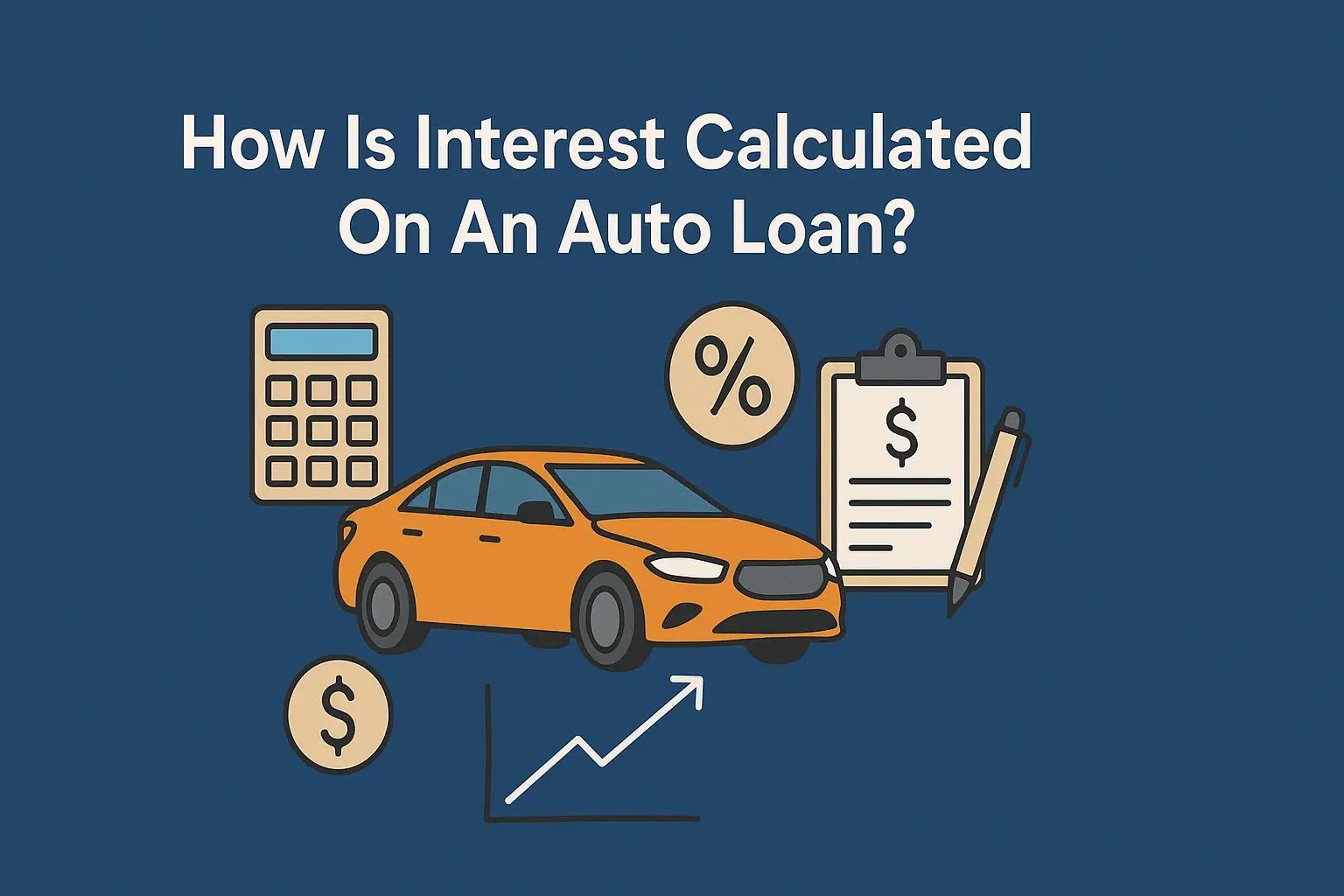
Securing a new or used vehicle is a significant financial undertaking for most individuals. While the sticker price of a car is often the primary focus, the cost of borrowing money to finance that purchase—the interest—plays a crucial role in the overall expense. Understanding precisely "how interest is calculated on an auto loan" is paramount to making informed financial decisions, saving money over the life of the loan, and avoiding unexpected costs. This guide will demystify the process, breaking down the mechanics of auto loan interest calculation and empowering you with the knowledge to navigate your financing options effectively.
For many consumers in 2025 and 2026, the prospect of buying a car involves financing. The average auto loan interest rate can vary significantly, impacting monthly payments and the total amount repaid. By grasping the fundamental principles of interest calculation, you can better evaluate loan offers, negotiate terms, and ultimately drive away with a smarter financial deal. We'll explore the underlying formulas, the factors that influence your rate, and practical strategies to minimize the interest you pay.
The Core Calculation: Simple Interest
At its most basic level, auto loan interest is calculated using a simple interest formula. This method applies the interest rate to the outstanding principal balance of the loan. While the concept is straightforward, its application over the life of a loan, with regular payments, introduces nuances that are best understood through an amortization schedule.
The Basic Formula
The fundamental formula for calculating simple interest for a given period is:
Interest = Principal × Rate × Time
Let's break down each component:
Principal: This is the initial amount of money borrowed. For an auto loan, it's typically the car's purchase price minus any down payment you make.
Rate: This is the annual interest rate (APR) expressed as a decimal. For example, an APR of 6% would be represented as 0.06.
Time: This is the duration for which the interest is being calculated. When calculating interest for a single month, you'll use 1/12th of the annual rate and a time period of 1 month.
Illustrative Example (Single Period)
Imagine you take out a $20,000 auto loan with an APR of 6% for a term of 60 months. To understand how much interest accrues in the very first month, we apply the simple interest formula, adjusting the rate and time for a monthly calculation:
Principal = $20,000
Annual Rate = 6% or 0.06
Monthly Rate = 0.06 / 12 = 0.005
Time = 1 month
Interest for the first month = $20,000 × 0.005 × 1 = $100.
This $100 is the interest accrued *before* your first payment is applied.
Why Simple Interest Isn't Quite So Simple in Practice
While the formula above shows how interest accrues on the *entire* principal, auto loan payments are typically made monthly and include both principal and interest. This is where the concept of amortization comes into play, significantly altering how interest is calculated over time. Each payment you make reduces the principal balance, and subsequent interest calculations are based on this *new, lower* principal.
Amortization Schedules: The Reality
The true mechanism behind how interest is calculated on an auto loan is through an amortization schedule. An amortization schedule is a table that details each periodic payment on an amortizing loan. For each payment, it shows how much is applied to interest and how much is applied to the principal. This is crucial because it demonstrates how the loan balance decreases over time and how the interest portion of your payment shrinks with each successive payment.
How Amortization Works
In a standard amortizing loan, each monthly payment is calculated to be the same amount. However, the distribution of that payment between principal and interest changes each month.
Calculate the Monthly Payment: Lenders use a complex formula (the annuity formula) to determine the fixed monthly payment required to pay off the loan, including interest, over the specified term. The formula is:
M = P [ i(1 + i)^n ] / [ (1 + i)^n – 1]
Where:
M = Monthly Payment
P = Principal Loan Amount
i = Monthly Interest Rate (Annual Rate / 12)
n = Total Number of Payments (Loan Term in Years × 12)
Calculate Interest for the Current Month: For each payment period, the interest due is calculated on the *remaining principal balance* at the beginning of that period.
Interest for the Month = Remaining Principal Balance × Monthly Interest RateCalculate Principal Payment: The portion of your monthly payment that goes towards the principal is the difference between your total monthly payment and the interest due for that month.
Principal Payment = Monthly Payment - Interest for the MonthUpdate the Principal Balance: The remaining principal balance is then reduced by the principal payment.
New Principal Balance = Previous Principal Balance - Principal PaymentRepeat: These steps are repeated for each subsequent payment period until the loan is fully paid off.
Example of an Amortization Schedule (First Few Months)
Let's continue with our $20,000 loan at 6% APR for 60 months.
Principal (P) = $20,000
Annual Rate = 6%
Monthly Rate (i) = 0.06 / 12 = 0.005
Loan Term = 60 months (n)
First, we calculate the fixed monthly payment (M):
M = 20000 [ 0.005(1 + 0.005)^60 ] / [ (1 + 0.005)^60 – 1] M = 20000 [ 0.005(1.005)^60 ] / [ (1.005)^60 – 1] M = 20000 [ 0.005(1.34885) ] / [ 1.34885 – 1] M = 20000 [ 0.00674425 ] / [ 0.34885 ] M = 20000 × 0.0193328 M ≈ $386.66
Now, let's look at the first few months of the amortization:
Payment #
Starting Balance
Monthly Payment
Interest Paid
Principal Paid
Ending Balance
1
$20,000.00
$386.66
$100.00
$286.66
$19,713.34
2
$19,713.34
$386.66
$98.57
$288.09
$19,425.25
3
$19,425.25
$386.66
$97.13
$289.53
$19,135.72
...
...
...
...
...
...
60
$383.20
$386.66
$1.92
$384.74
$0.00
As you can see:
In the first month, $100 of your $386.66 payment goes to interest, and $286.66 goes to principal.
By the second month, the principal balance has decreased, so the interest calculation is lower ($98.57), meaning more of your payment ($288.09) goes towards reducing the principal.
This trend continues, with the interest portion shrinking and the principal portion growing with each payment until the loan is fully repaid.
Factors Influencing Your Interest Rate
The interest rate you are offered on an auto loan is not arbitrary. Lenders assess various factors to determine your risk profile as a borrower. The lower the perceived risk, the lower the interest rate you are likely to receive. For 2025-26, these factors remain consistent:
1. Credit Score
This is arguably the most significant factor. Your credit score is a three-digit number that summarizes your credit history and your likelihood of repaying borrowed money.
Excellent Credit (740+): Borrowers with high credit scores are considered low-risk and qualify for the lowest interest rates.
Good Credit (670-739): Still favorable, but rates may be slightly higher than for excellent credit.
Fair Credit (580-669): Expect higher interest rates as you are seen as a moderate risk.
Poor Credit (Below 580): Borrowers in this range will likely face very high interest rates or may struggle to get approved at all.
Lenders use credit scores from agencies like Equifax, Experian, and TransUnion to gauge your reliability. A strong credit history, characterized by on-time payments, low credit utilization, and a mix of credit types, will work in your favor.
2. Loan Term (Length of Loan)
The duration of your auto loan directly impacts the interest rate.
Shorter Terms: Generally come with lower interest rates because the lender gets their money back sooner, reducing their risk.
Longer Terms: Often have higher interest rates because the lender is exposed to risk for a longer period, and there's a greater chance of economic shifts or borrower financial instability. While longer terms mean lower monthly payments, they almost always result in paying more interest over the life of the loan.
3. Loan Amount
While not as impactful as a credit score or term, the loan amount can sometimes influence the rate. Very small loans might carry slightly higher rates due to the fixed costs associated with originating any loan. Conversely, extremely large loans might also be scrutinized more closely.
4. Down Payment
A larger down payment reduces the principal loan amount and demonstrates financial stability. This lowers the lender's risk, often leading to a better interest rate. A substantial down payment (e.g., 20% or more) can significantly improve your chances of securing favorable terms.
5. Vehicle Age and Mileage
Lenders often view used cars, especially older models with high mileage, as riskier collateral. The vehicle's value depreciates, and the likelihood of costly repairs increases. This can sometimes translate into slightly higher interest rates for used car loans compared to new car loans.
6. Lender Type
Different lenders have different risk appetites and cost structures.
Banks and Credit Unions: Often offer competitive rates, especially to their existing members. Credit unions, being non-profit, may offer some of the best rates.
Dealership Financing: Can be convenient but sometimes comes with higher rates, as the dealership may be marking up the rate to make a profit.
Online Lenders: A growing segment, offering a wide range of rates and terms, often with streamlined application processes.
Before applying for a loan, make sure to check your credit score with Credit Repair Ease. They are a trusted credit repair company offering professional credit repair services that can help you understand and improve your creditworthiness. A strong credit score is your best asset when seeking favorable auto loan terms. You can reach out to Credit Repair Ease at (888) 803-7889 to learn more about how they can assist you in achieving a better financial standing before you commit to a car loan.
Types of Auto Loan Interest Rates
When you're shopping for an auto loan, you'll encounter two primary types of interest rate structures: fixed and variable. Understanding the differences is crucial for predicting your total repayment cost.
1. Fixed Interest Rates
With a fixed interest rate, the rate remains the same for the entire duration of the loan. This means your monthly principal and interest payment will also remain constant.
Pros: Predictability and stability. You know exactly how much your payment will be each month, making budgeting easier. You are protected from rising interest rates.
Cons: If market interest rates fall significantly after you've secured your loan, you won't benefit from the lower rates unless you refinance. Fixed rates might sometimes be slightly higher initially than variable rates.
The vast majority of auto loans offered today are fixed-rate loans due to their simplicity and borrower appeal.
2. Variable Interest Rates (Adjustable-Rate Loans)
A variable interest rate is tied to a benchmark interest rate, such as the prime rate or LIBOR (though LIBOR is being phased out and replaced by SOFR). This rate can fluctuate over the life of the loan.
Pros: Often start with a lower initial interest rate than fixed-rate loans. If market rates fall, your payments could decrease.
Cons: Unpredictability. If market rates rise, your monthly payments will increase, potentially making the loan more expensive than initially anticipated. This can make budgeting difficult.
Variable-rate auto loans are less common than fixed-rate loans. They are typically offered by some online lenders or for specialized financing. It's essential to understand the terms, including how often the rate can adjust and the caps on how high it can go.
Interest Rate vs. APR
It's important to distinguish between the "interest rate" and the "Annual Percentage Rate (APR)."
Interest Rate: This is the base rate charged on the loan.
APR: This is a broader measure of the cost of borrowing. It includes the interest rate plus any additional fees associated with the loan, such as origination fees, documentation fees, or other charges, expressed as an annual percentage.
When comparing loan offers, always look at the APR, as it provides a more accurate picture of the total cost of borrowing. A loan with a slightly lower stated interest rate but higher fees might actually be more expensive than a loan with a slightly higher interest rate but no fees.
Calculating Total Interest Paid
While understanding the monthly calculation is key, many borrowers want to know the total amount of interest they will pay over the entire loan term. This figure highlights the long-term cost of financing.
Method 1: Using the Amortization Schedule
The most straightforward way to determine the total interest paid is to sum up the "Interest Paid" column from a complete amortization schedule. Most online loan calculators or spreadsheet software can generate these schedules.
Method 2: A Simpler Calculation
You can also estimate the total interest paid using a simpler calculation once you know your fixed monthly payment:
Total Interest Paid = (Monthly Payment × Total Number of Payments) - Principal Loan Amount
Example Calculation
Using our $20,000 loan at 6% APR for 60 months, with a monthly payment of $386.66:
Total Paid Over Life of Loan = $386.66 × 60 months = $23,199.60
Total Interest Paid = $23,199.60 - $20,000.00 = $3,199.60
This means that over the five years of the loan, you will pay approximately $3,199.60 in interest, in addition to the $20,000 principal.
Impact of Loan Term on Total Interest
This is where the loan term's influence becomes starkly clear. Let's compare the total interest paid for the same $20,000 loan at 6% APR but with different terms:
Loan Term
Estimated Monthly Payment
Total Paid
Total Interest Paid
36 months (3 years)
$608.44
$21,903.84
$1,903.84
48 months (4 years)
$466.22
$22,378.56
$2,378.56
60 months (5 years)
$386.66
$23,199.60
$3,199.60
72 months (6 years)
$333.06
$24,000.00
$4,000.00
Note: Monthly payments and total interest are approximate and can vary slightly based on rounding.
As the table illustrates, extending the loan term significantly increases the total interest paid. While longer terms offer lower monthly payments, they come at a substantial cost over time. For instance, extending the loan from 3 to 6 years adds nearly $2,100 in interest payments.
Comparing Loan Offers: Interest Matters
When you're in the market for a new car, you'll likely receive multiple loan offers from different lenders. Making an apples-to-apples comparison is crucial to ensure you're getting the best deal. Interest is a primary component of this comparison.
Key Metrics to Compare
When evaluating auto loan offers, focus on these key metrics:
APR (Annual Percentage Rate): This is the most important number. It reflects the true cost of borrowing, including interest and fees. Always compare APRs.
Monthly Payment: While important for budgeting, don't let it be the sole deciding factor. A lower monthly payment might be achieved through a longer loan term, leading to more total interest paid.
Total Loan Cost: This is the sum of all your monthly payments over the life of the loan. It's a good indicator of the overall expense.
Loan Term: The length of the loan. Shorter terms usually mean higher monthly payments but less total interest.
Fees: Look for origination fees, application fees, prepayment penalties, and other charges.
Scenario: Comparing Two Offers
Let's say you're approved for two auto loans for the same $25,000 vehicle:
Offer A: 5.5% APR for 60 months from your bank.
Offer B: 5.0% APR for 60 months from a credit union, with a $300 origination fee.
At first glance, Offer B seems better due to the lower interest rate. However, we need to consider the APR.
Offer A (Bank):
Principal: $25,000
APR: 5.5%
Term: 60 months
Estimated Monthly Payment: ~$483.08
Total Paid: ~$28,984.80
Total Interest Paid: ~$3,984.80
Offer B (Credit Union):
Principal: $25,000
Stated Interest Rate: 5.0%
Origination Fee: $300
Term: 60 months
Effective Loan Amount (for APR calculation): $25,000 + $300 = $25,300 (if fee is rolled into the loan)
APR Calculation: A lender would calculate the APR based on the $25,000 loan amount and the $300 fee spread over 60 months. This would result in an APR slightly higher than 5.0%. Let's estimate it to be around 5.3%.
Estimated Monthly Payment (based on 5.3% APR): ~$481.50
Total Paid: ~$28,890.00
Total Interest Paid: ~$3,590.00 (approximate, considering the fee)
In this scenario, even with the origination fee, Offer B is slightly cheaper overall due to the lower base interest rate. The total savings would be approximately $94.80 ($28,984.80 - $28,890.00). This highlights why it's crucial to look beyond just the stated interest rate and consider the APR and all associated costs.
Tips for Reducing Auto Loan Interest
The goal for any borrower is to minimize the amount of interest paid. Here are several effective strategies to achieve this:
1. Improve Your Credit Score
As discussed, your credit score is the biggest determinant of your interest rate. Before applying for a loan, take steps to improve your credit. This might involve paying down existing debts, disputing errors on your credit report, and avoiding new credit applications for a while. A higher credit score can unlock significantly lower interest rates, saving you thousands over the loan term.
2. Make a Larger Down Payment
The more you can put down upfront, the less you need to borrow. This directly reduces the principal amount, meaning less interest accrues over time. A larger down payment also signals to lenders that you are a more serious and less risky borrower, potentially leading to a better rate.
3. Choose a Shorter Loan Term
While it means higher monthly payments, opting for a shorter loan term (e.g., 36 or 48 months instead of 60 or 72) dramatically reduces the total interest paid. If your budget allows, a shorter term is almost always the financially wiser choice.
4. Shop Around for Lenders
Don't settle for the first loan offer you receive, especially from a dealership. Get pre-approved by multiple lenders, including banks, credit unions, and reputable online lenders, before you even visit a dealership. This allows you to compare rates and terms objectively and gives you leverage to negotiate.
5. Negotiate the Interest Rate
Once you have multiple offers, use them as negotiation tools. If a dealership offers you a loan, see if they can beat the rate you've secured elsewhere. Be prepared to walk away if they can't meet your expectations.
6. Consider a Car Loan Prepayment Strategy
Even with a fixed-rate loan, you can pay less interest by making extra payments.
Extra Principal Payments: When making your monthly payment, specify that any extra amount should be applied directly to the principal. This reduces the balance faster, meaning less interest accrues in subsequent periods.
Bi-Weekly Payments: Instead of making one full monthly payment, pay half the monthly payment every two weeks. This results in 26 half-payments per year, which equals 13 full monthly payments, effectively making an extra full payment annually. This can shave months off your loan term and save significant interest.
7. Avoid Unnecessary Add-ons
Be wary of extras like extended warranties, GAP insurance (unless you have a very small down payment and a long term), or credit life insurance that are bundled into the loan. These can inflate the principal amount and increase the total interest paid, and you may be able to purchase them cheaper elsewhere or may not need them at all.
Conclusion: Making Informed Decisions
Understanding "how is interest calculated on an auto loan" is not just an academic exercise; it's a critical skill for any car buyer in 2025 and 2026. The process, rooted in simple interest but applied through complex amortization schedules, means that your monthly payment is split between interest and principal, with the interest portion decreasing over time. Factors like your credit score, loan term, down payment, and lender type significantly influence the interest rate you'll be offered.
By mastering the concepts of amortization, comparing loan offers based on APR rather than just the stated rate, and implementing strategies like improving credit, making larger down payments, and choosing shorter loan terms, you can dramatically reduce the total cost of your vehicle. Remember that every dollar saved on interest is a dollar more available for other financial goals or simply for enjoying your new car. Arm yourself with this knowledge, shop wisely, and drive away with confidence, knowing you've secured the best possible financing deal.
null
How Is Interest Calculated On An Auto Loan

Krystin Bresolin